6 min read
"Blockchain: What is Decentralization? What is a Fork?"
This article is Lu Canwei's 135th original piece.
Click the blue 【Lu Canwei】 above to follow; remember to add a ⭐️ star mark~
Recently, the cryptocurrency market has exploded due to Elon Musk promoting Dogecoin, and many old friends who had never entered the market before are coming to ask me how to play. A large number of uninformed new investors are entering the market without even knowing what buying things entails. To be honest, it would be better to go directly to Macau; at least there are sexy dealers (though it seems that's not the case anymore).
As an old investor in the cryptocurrency space, I haven't paid much attention since being harvested in 2017. At the end of last year, I took a friend's advice and converted the remaining funds into positions. Recently, I found that I have broken even, but the ecology of the cryptocurrency market has undergone tremendous changes. Various liquidity mining, DeFi, lending, and terms like BSC, Heco, ERC20, TRC20 are all unclear to me. New investors don't even understand how to transfer funds, and without even the opportunity to be harvested, they make mistakes and incur losses.
Therefore, I plan to start a new topic related to blockchain, mainly for content popularization, without discussing any investment-related content. I will try to explain with some examples, and if there are any mistakes, please feel free to point them out.
Blockchain Technology
What is blockchain technology? Blockchain is a type of "decentralized database" technology.
So what is centralization, and what is decentralization?
Centralization
Centralization refers to data being recorded under a single entity, which can be an individual or a company.
For example, if Xiao Ming borrows 1,000 yuan from Lao Wang, Xiao Ming records the loan in his notebook, and Lao Wang also records in his notebook that he borrowed 1,000 yuan from Xiao Ming. This loan data is recorded. However, when Xiao Ming goes to repay Lao Wang, Lao Wang might say, "No, you recorded it in your notebook; this never happened." At this point, Xiao Ming would be very frustrated...
For companies, it's easy to understand. If you transfer 1,000 yuan to another person on WeChat, Tencent records two lines of data in a massive Excel spreadsheet (database) on its server: Xiao Ming transferred 1,000 yuan to Lao Wang, and the account balance decreased by 1,000 yuan. Lao Wang receives Xiao Ming's 1,000 yuan, and his account balance increases by 1,000 yuan. However, at this moment, the 1,000 yuan is not with Lao Wang; it is in the WeChat wallet. To withdraw it, he must transfer it to his bank card and then withdraw cash from the bank.
So if one day Tencent goes bankrupt, does that money disappear? Or if one day a program error occurs, and the first line of data shows that Xiao Ming gave Lao Wang 10,000 yuan while the second line shows that Lao Wang only received 1,000 yuan, then 9,000 yuan would be missing. Anything is possible; just look at how Lehman Brothers collapsed. Of course, all of the above are hypothetical. For example, if a program error occurs, there will be system monitoring to promptly correct the operation (you can understand that the system will automatically fix these discrepancies or return the funds to rectify the situation), but essentially, the company has ownership over the operation of your data.
For you, all of this is a black box; you cannot see what happens inside. If a trusted third party defaults, you have no countermeasures. Thus, in this context, the concept of a decentralized database was proposed by someone named Satoshi Nakamoto.
Decentralization
In the example above, when Xiao Ming lends Lao Wang 1,000 yuan, both Xiao Ming and Lao Wang call upon their relatives to witness the transaction, and each records in their notebooks that Lao Wang borrowed 1,000 yuan from Xiao Ming. When Xiao Ming later asks Lao Wang for the money, Lao Wang has to admit that Xiao Ming indeed transferred 1,000 yuan to him.
At this point, the relatives might complain, saying, "Look at how much time we spent recording your loan; shouldn't you consider giving us some compensation? We can't work for free." Therefore, a portion of the transaction needs to be allocated as a transfer fee to the relatives.
However, since everyone recorded it, who gets the fee? So they came up with a solution: the first person to record the transaction (proof of work, which I won't explain in depth here; you can understand it as needing a computer to solve super complex mathematical problems) can receive this fee. But where should these records be stored? Since today we recognize A's record and tomorrow we recognize B's record, it becomes inconvenient to check. So everyone agreed to find a place to store these records, where everyone has a key, can only view but not modify, and everyone agreed.
However, this place is a bit far from everyone's home, making it inconvenient to visit. So the person who established this place suggested that every time someone comes over, they should give a certain reward to the person who organizes the records, making everyone more willing to organize these records.
The unified storage place for records mentioned earlier is the network, such as the Bitcoin network, Ethereum network, etc. In the network, there is a very long table where notebooks are arranged in order. By looking down from the first notebook, we can see the earliest transaction to the latest transaction. This table is called a chain, and each notebook is called a block, while the act of organizing these notebooks is called packaging.
Forking
As more and more people began recording transactions, congestion occurred. It’s like a traffic lane; initially, there was only a single lane, but as more cars arrived, it became very congested. Some people wanted their records to be processed faster, so they started raising their fees to attract priority recording, while others were unhappy, saying, "I’m transferring 1 yuan, and you’re charging me 100 yuan in fees."
Then some people suggested finding a larger place and planning a new highway. However, some people were unwilling, saying, "I was doing fine on the original road, and now you want me to take another route."
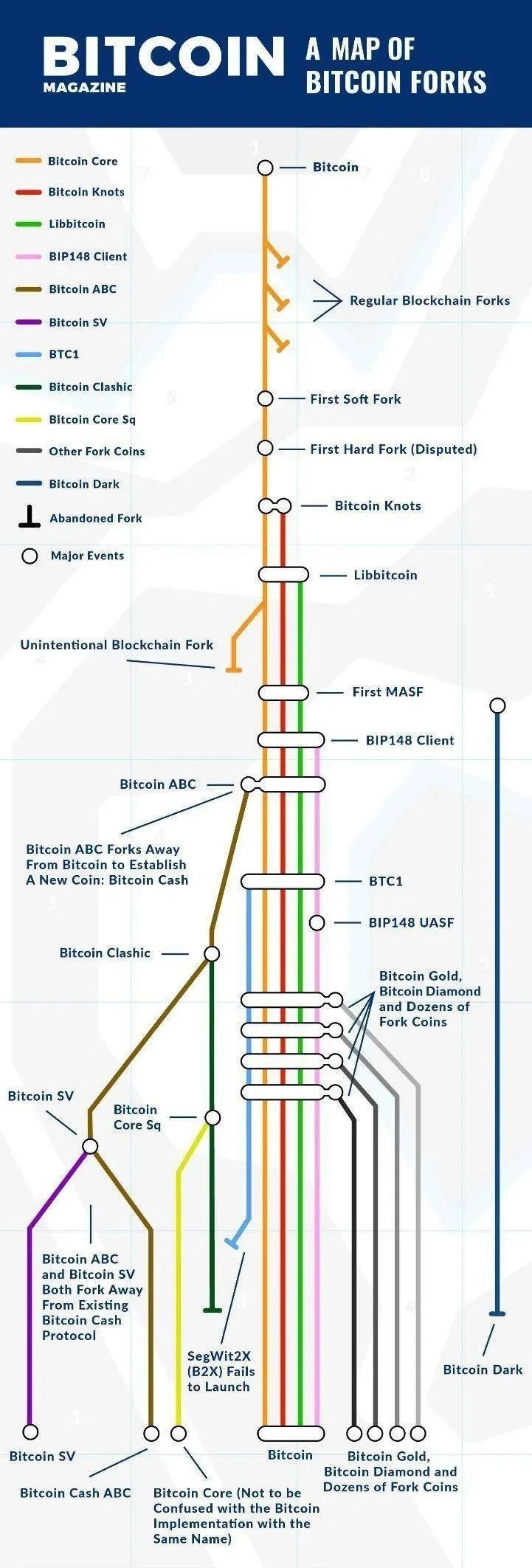
This is called a hard fork, which I won't elaborate on here. When the new highway is established, some people may find it inconvenient again, leading to another fork. The history of Bitcoin forks can be referenced in the image below.
Another type is a soft fork, where some people suggest opening a service road next to the lane to increase throughput. However, the problem with this approach is that after a few years, congestion may occur again, failing to address the root issue.
Recommendations:
Those who are very capable are actually ordinary people.
Cherishing the present is the most important thing.
The consensus of speculation; you don't even have the qualification to be harvested.
Once you leave the platform, you are nothing.
Thinking about getting rich quickly is just a thought; what you should do is gradually become wealthy.
Scan the code to follow 【Lu Canwei】, and send "self-media materials" in the background to receive two benefits for free.
1. A self-media tool package (worth 1,999 yuan).
2. An electronic version of the "2020 Wealth Calendar," containing 365 money-making tips.
👇👇👇 Welcome to click and follow~
"Looking" is the strongest support ↘