3 min read
"Do You Also Need to Review Your Work?"
This article is Lu Canwei's 22nd original piece.
Last week, I had the privilege of attending a review session led by Teacher Xu, where I learned how to conduct efficient reviews and gained insights into the PDCA and SMART frameworks. During the session, there was a case study, and although it was our first meeting, everyone expressed their true colors during the heated discussions about the case.
Case Study
Story Background:
A certain internet education company successfully raised one billion RMB in financing in 2015, becoming the first unicorn in the industry. They aimed to achieve a revenue target of one billion in 2016, even if it meant a slight loss. However, the actual revenue in 2016 was only six billion, resulting in a loss of ten billion. Currently, the team's morale is low, and there is a serious issue of blame-shifting.
Internal Environment
After the company secured financing, a large number of core personnel were replaced, with professional managers from unrelated industries joining the company;
The average product price was set at 5,000 RMB, with hopes to raise it to 10,000 RMB, but this was not successful;
To increase the average transaction value, the marketing team spent a huge amount on promotions, inviting a celebrity to endorse the campus market, and later heavily investing in a well-known female star to promote the white-collar market;
The company values its internet DNA, with 42% of its personnel being technical staff, accounting for 60% of a 300 million RMB labor cost.
External Environment
The company's main product focuses on adult foreign language education, but there is a trend towards K12 education in the external environment; the cost of internet traffic is high, with customer acquisition costs reaching 3,000 RMB.
If you were part of the company's management, what would you do? Everyone can leave comments, and I will share them. I will also update some conclusions from that day, and I welcome everyone to engage in a battle of ideas and learn from each other.
Review Meeting
Interestingly, even in this fictional case, the first thing everyone did during the review was to shift blame. The head of course research immediately accused the marketing head, saying that so much money was spent with no results. The marketing head retorted that the course research team could not develop competitive products. There were also complaints about the high proportion of technical staff in labor costs and the failure to transition to K12 trends.
I, who had been silent, also got caught in the crossfire, with someone saying I was uninvolved, oh right, I forgot to mention that I was labeled as the CEO.
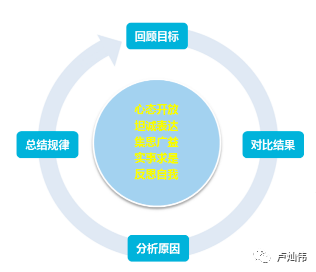
The review process consists of four steps, as shared by Teacher Xu:
1. Review the Goals (What were the initial goals? Were the goals effectively achieved? How do we view the goals we set at that time now?)
2. Compare Results (How do the results compare to the goals? What actually happened? What were the highlights? What were the shortcomings?)
3. Analyze Reasons (What caused the success? What caused the failure to meet the expected goals? What if a different situation had occurred?)
4. Summarize Patterns (What did we learn from this? What should not have happened? What should be eliminated? Why? What needs improvement? What should be maintained? What can we do more of? What can be internalized as standardized processes?)
5. What are our next actions?
Case Breakdown
If we break down the case according to the above steps, here are some of my thoughts and ideas, which do not constitute a reference.
Review the Goals
What were the initial goals: Revenue of one billion in 2016, with a slight loss.
Were the goals effectively achieved: No, they were not achieved.
How do we view the goals we set at that time now: Close to the target, but with significant losses.
Compare Results
How do the results compare to the goals: Revenue of six billion, with a loss of ten billion.
What actually happened:
What were the highlights: Revenue of six billion in 2016.
What were the shortcomings:
Summarize Patterns
What did we learn from this?
Celebrity endorsements and increasing average transaction value are not directly related.
What should not have happened?
What should be eliminated? Why?
What needs improvement?
What should be maintained?
What can we do more of?
What can be internalized as standardized processes?
Action Plan
Finally
Whether for teams or individual career planning or other aspects, I recommend that everyone conduct regular reviews. The SMART principles mentioned earlier can also be searched for independently.
行动计划
最后
无论是团队还是个人职业规划或者各个方面,建议大家也定期复盘,前面提到的SMART原则大家也能去自己搜索一下。