7 min read
"From Takeout Operations Basics to Mastery"


It has been over a month since I last wrote an article. A couple of days ago, I noticed that a friend liked my previous article, which reminded me that I still have a public account to write for. At this rate, if nothing unexpected happens, I will produce 12 "high-quality" articles in a year.
Why did I suddenly want to write an article about food delivery? On one hand, there has been quite a stir recently regarding Meituan's commissions. If I remember correctly, the platform's cut is around 20%, which is old news. The recent pandemic has caused many catering businesses to collapse, and Meituan's plan to waive service fees has been criticized for not being able to withdraw funds, leaving only promotional spending. Many articles have been written on this topic with different viewpoints, and those interested can search for them themselves.
On the other hand, I have recently been helping a client's father with some data analysis, which has given me insight into some of the platform's functions and data. This has allowed me to get a foothold in operations.
Through this period of practice, I have learned that food delivery operations mainly consist of several parts. I won’t go into detail about the external aspects, such as brand upgrades, offline store renovations, and KOL store visits. Today, I will mainly discuss the internal aspects.
I have not actually operated a store, so I won’t elaborate on that. Opening a store is probably the most challenging part, as it involves the process of going from 0 to 1. To this day, the client's father still has a store on Ele.me that cannot be listed.
Store
The store mainly involves adjustments related to basic information. The most frequently adjusted items are the header image and posters. Another important aspect is the display of bestsellers and categories, as these two will directly affect the order conversion rate. Posters are more about advertising the brand's hot promotions, such as promoting afternoon tea sets or lunch specials. From recent observations, the conversion rate from merchant recommendations has not been as high. I must vent about Ele.me here; the order of posters cannot be adjusted, so if you want a sequence of 1, 2, 3, you need to upload them in the order of 3, 2, 1.
Another area to pay attention to is delivery-related aspects, such as the minimum order amount, delivery fees, and the delivery range. It’s best to outline the delivery area closely following the roads, as the platform provides a circular area of a few kilometers. If you are a store in Lujiazui and determine the delivery range based on the circle, you might end up losing half of your business into the Huangpu River.
Products
The first aspect is the quantity of products. You can optimize and adjust based on the same business district and category provided by the platform, quickly optimizing out products with low sales. This affects the store's inventory and, over time, products that are listed without stock will impact the store's rating, thus affecting the store's ranking and leading to a decrease in exposure. In the case of insufficient inventory, order cancellations will also affect the store's ranking weight. There have been instances where inventory issues led to an increase in order cancellations, causing the homepage ranking to drop from 15th to 25th, with a 30% decline in orders.
Another point for catering businesses is to minimize single-item drinks. For example, a large vanilla latte and a medium vanilla latte should be merged into one product. Having the same image and name will significantly affect the order conversion rate.
Orders
Currently, it is important to pay attention to order reminders and cancellations, as these significantly impact the store's ranking weight. Order reminders can lead to a very poor user experience, resulting in negative reviews, which directly lowers the store's rating. It then requires positive reviews to offset the negative ones, and once you have negative reviews, it can be quite troublesome.
The reasons for invalid orders on Ele.me are quite straightforward, while those on Meituan are harder to understand. Ele.me provides detailed explanations, such as: merchant cancels order (reason: due to delivery issues, user cancels order (merchant reason)). Meituan only has a vague "sys cancel" and "uniformRefund." Currently, from the order perspective, one is user cancellation, and the other is merchant cancellation.
Marketing
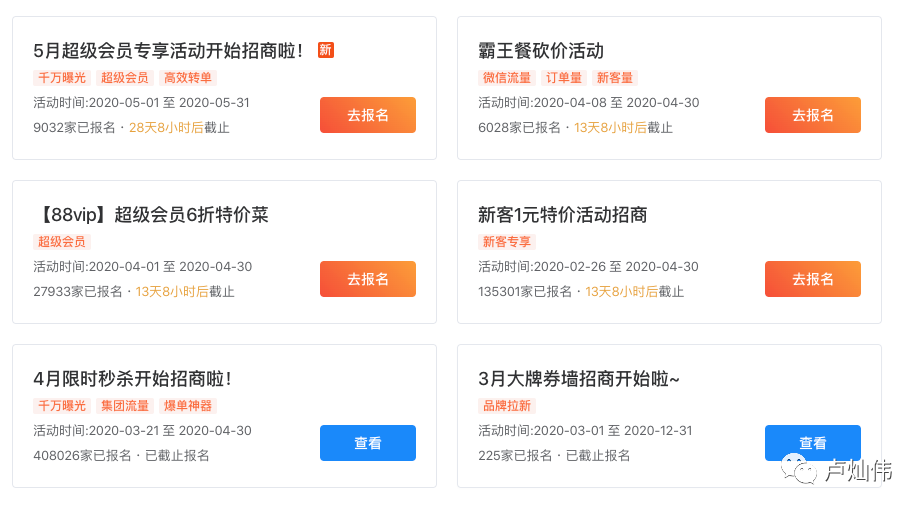
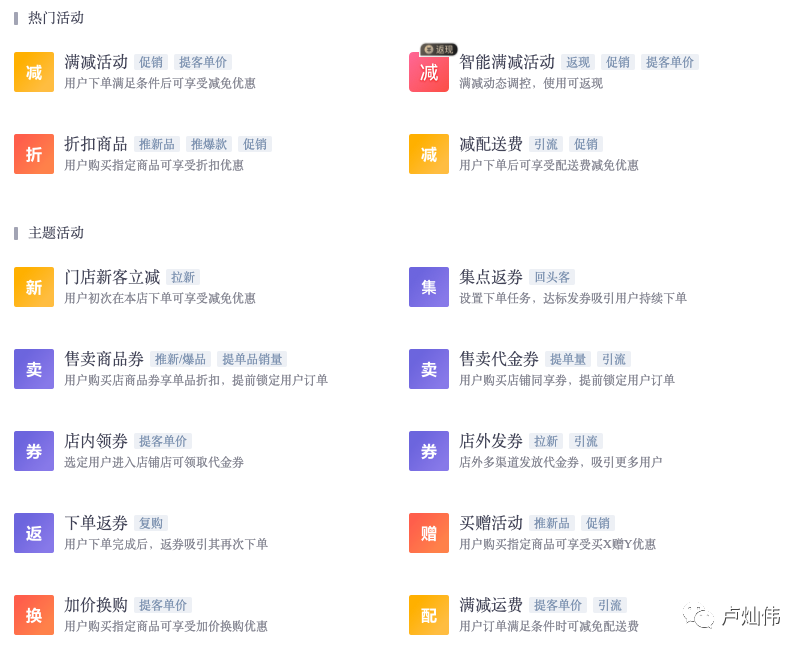
Marketing is primarily activity-based. One type is platform activities, and the other is the store activities you see daily, such as discounts and promotions. For platform activities, it’s best to participate as much as possible to increase exposure, along with discounts and coupons to level the playing field with others.
Platform Activities
Store Activities
Data
In terms of data, we are mainly concerned with some operational and customer flow data.
Operations: Average order value, valid orders, revenue
Customer Flow: Exposure, store entry rate, order conversion rate
However, there are some differences in the statistical dimensions between Meituan and Ele.me's backends. Ele.me mainly calculates the average order value based on the actual payment made by customers. For example, if you buy a set meal that costs 40 yuan but only pay 20 yuan, Ele.me counts the average order value as just 20 yuan, which we can consider as the net average order value.
Meituan's calculation method is different; it is based on the original price. So, your original price of 40 yuan may include (20 yuan for the set meal + 5 yuan for delivery + 4 yuan for platform service fee + 3 yuan for platform subsidy + 8 yuan for merchant subsidy). Of course, the above is just an example. Therefore, the average order value calculated in Meituan's backend will be much higher than that of Ele.me.
We need to clarify a few numbers mentioned above.
At first, I was also quite confused, so I will use numbers to illustrate for better understanding.
For example:
Assuming your revenue is 80 yuan, this 80 yuan will include (product sales 40 yuan, platform service fee 8 yuan, packaging fee 2 yuan, delivery fee 5 yuan, merchant subsidy 20 yuan, platform subsidy 5 yuan).
Your expenses (platform service fee 8 yuan, merchant subsidy 20 yuan).
Your income (packaging fee 2 yuan, delivery fee 5 yuan, product sales 40 yuan, platform subsidy 5 yuan).
Customer payment (packaging fee 2 yuan, delivery fee 5 yuan, product sales 40 yuan).
Exposure mainly refers to the number of people exposed and the number of exposures. From an advertising perspective, the number of people in the area has a fixed threshold. Once exceeded, the platform will repeat the exposure, leading to a low overall ROI, which will make your order conversion rate look worse. Therefore, advertising needs to be monitored in real-time based on the business district situation and ranking.
Promotion
Finally, let’s talk about promotion. The most commonly used method is bidding for rankings. Of course, bidding for rankings does not mean that spending more money is better. From the perspective of the two platforms' differences, Ele.me's prices are relatively low due to the exposure effects of official platform activities. Overall, the CPC (cost per click) ranges from 1.6 to 2.5. On the other hand, Meituan relies heavily on bidding for rankings, so the CPC can go above 4 yuan.
In terms of advertising, Meituan can separate advertising for weekdays and weekends, but can only target specific time slots, such as breakfast, lunch, afternoon tea, dinner, and late-night snacks. Ele.me can split advertising across all time slots but cannot separate weekdays and weekends. For new customers, homepage, category, and returning customer price increases, both platforms can fully cover these, but Meituan can adjust prices based on different time slots.
In terms of advertising positions, Meituan has many advertising positions. Currently, they have experimented with two positions: Super Traffic Card and Recommended for You, but neither has been very ideal. Recommended for You is actively exposed, so when you open the app, it has surprisingly high exposure but zero conversion. The Super Traffic Card can accumulate some exposure conversion, but currently, it has a lower click-through rate than bidding promotions and can only be advertised on a weekly basis.
Conclusion
Finally, as a side note, I want to mention the gray market of food delivery fake orders. I have heard about fake orders for a long time, and it sounds very high-tech. However, as someone with a technical background, I believe that the platform should have strict risk control over these fake orders, so I am curious about how they operate.
First, let’s talk about fake orders. As the name suggests, fake orders are orders that do not result in actual behavior. They are created through various means to write in virtual orders, but they are usually detected by risk control, which can lead to store suspensions. Therefore, very few people engage in fake orders now, accounting for only about 10% of orders. However, due to the high volume of merchant orders, the platform often turns a blind eye.
Next, let’s discuss real orders, which can be divided into two types. One type is order-faking companies. These companies will find a bunch of phone numbers and help you order takeout nearby, but these orders will ultimately be discarded. Since it is a business-to-business connection, it requires accounting, and excluding the cost of catering itself, the fee you pay per order will not be low.
The other type involves many people creating benefit groups, where everyone participates in getting discounts. Generally, the costs in such cases are relatively low. The organizer will find suitable people in the group they manage and treat them to a meal for free. To some extent, this can also be considered normal consumption.
Lastly, as usual, this article is brought to you by the boss... Background image to conclude.