5 min read
"How Bandwidth Burden Causes Our IQ to Drop"
This article is the 76th original piece by Lu Canwei.
Click the blue 【Lu Canwei】 above to follow; remember to add a ⭐️ star mark~
Today I saw an article stating that most books contain between 100,000 to 200,000 words. If you want to absorb knowledge, you need to rely on writing. When you write more than 200 notes of 200-500 words each from a book, you can truly absorb the content.
In our lives, there is a lot of "noise." For example, Bitcoin has just surpassed $60,000 today, and many people are wondering if it's still a good time to enter the market. Some say it will break $100,000, while others claim that governments of various countries will start implementing policies to intervene, causing it to drop to zero. However, these seem to have little to do with my writing.
Scientists once conducted a study at a school located next to a railway. They found that students on the railway side performed academically a full year behind those on the quieter side. After the results were published, the city government installed special noise insulation equipment, and then they discovered that the gap between students disappeared.
Compared to the physical noise, the noise in our thoughts is even more abundant. For instance, seeing the recent fluctuations in various markets, like my continuously declining funds and the rising digital currencies, or major events in countries like the U.S. and India, even down to whether I stepped out with my left or right foot today, can lead us to drift for a long time before we focus on what truly matters.
Scarcity causes us to overload our brains with other processing content, leaving less bandwidth for the current task. Scientists use the term "bandwidth" to refer to two types of elements in mental function.
So, what is fluid intelligence? Fluid intelligence, also known as fluid reasoning, has a related concept called crystallized intelligence. These two concepts were initially distinguished by American psychologist Raymond Cattell in 1971. Crystallized intelligence refers to the ability to apply previously acquired knowledge and experience; conversely, fluid intelligence refers to the ability to find meaning (new knowledge) and solve new problems in chaotic situations.
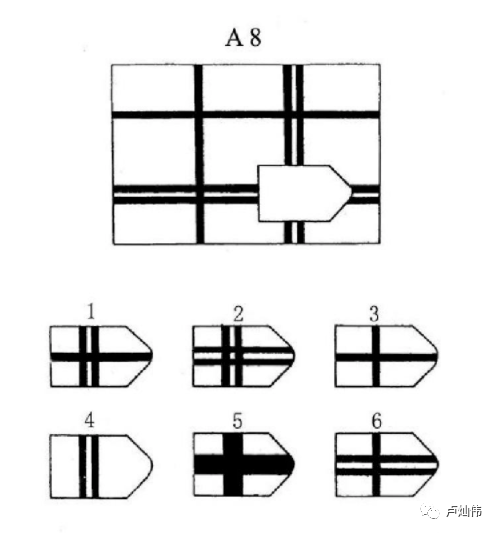
How can we test our fluid intelligence? I believe many of you have encountered pattern reasoning questions in various exams, similar to the images below.
These questions are known as Raven's Progressive Matrices, a non-verbal intelligence test developed by British psychologist John Carlyle Raven in 1938. It is currently the most common method for psychologists, educators, and the military to test fluid intelligence, allowing for the evaluation of someone's logical reasoning ability and problem-solving skills independent of background knowledge.
Scientists designed a problem: when your car breaks down and needs $300 for repairs, do you decide to fix it now or drive it a bit longer? They paired this with the aforementioned Raven test to assess the IQ of the subjects, categorizing them into poor and wealthy based on income. The conclusion was that the rich and the poor are equally intelligent.
They then tested another group of subjects in the same way, but this time the repair cost was changed from $300 to $3,000. The results changed significantly; for those who were not very wealthy, gathering $3,000 for car repairs posed a considerable challenge. A survey conducted in 2011 found that nearly half of Americans could not come up with $2,000 within 30 days, which explains why the U.S. has continually implemented fiscal stimulus plans during the COVID-19 pandemic, allowing most Americans to receive financial aid.
The scarcity of money quickly fills the bandwidth of the poor's brains. For instance, they might think about how long they can continue driving the car without repairs and whether it would be dangerous. They might also consider how not driving would disrupt their lives, and if they take out $3,000, what will happen to their other bills, and how will they manage their credit score, etc. It is evident that scarcity has spread the simple judgment of car repairs throughout their entire brain.
They found that the poor performed significantly worse on tests than before; their IQ dropped sharply because scarcity led to anxiety, which in turn lowered their level of fluid intelligence. In subsequent tests, scientists added rewards for each question. For low-income individuals, answering correctly could earn them money, but when faced with the $3,000 repair cost, their performance was still worse than when they faced the $300 repair cost.
Do you remember the examples of delayed gratification that are all over the internet? Scientists had some children sit in a room with a marshmallow in front of them. If they did not eat the marshmallow before the scientists returned, they would receive a second one. They found that the children who did not eat the marshmallow managed to distract themselves from it, thus avoiding the struggle against their desire to eat it.
As the experiment's creator Walter Mischel said, "Once you realize that willpower is just learning how to control your attention and thoughts, you can start to improve your willpower."
To further validate this claim, scientists conducted another experiment where they presented a group of students with a food they found repulsive to test whether they could maintain civility at the dinner table under pressure. Another group of students was asked to remember a sequence of eight digits. The results showed that students who did not have to remember the numbers maintained their composure well, while those with a high cognitive load could not help but curse.
Scarcity creates a bandwidth burden, reduces fluid intelligence, and diminishes self-control. Understanding this allows us to comprehend many anti-intellectual behaviors in others; in their minds, their bandwidth may be fully occupied, with both intelligence and self-control on the brink of losing control.
So how can we recognize our own anti-intellectual behaviors? We can try recording some of our daily actions and then review these records from a third-person perspective after a day.
Recommendations:
The impact of focus dividends and a narrow mindset on us
How 996 has changed our lives
Sharing some software I commonly use
The power of empathy
How to better manage our emotions when facing long-term goals
What did the "Night Talk on Wealth Creation" really discuss?
Scan to follow 【Lu Canwei】, and send "self-media materials" in the background to receive two free benefits:
1. A self-media tool kit (valued at 1999 yuan)
2. An electronic version of the "2020 Wealth Creation Calendar," containing 365 money-making tips;
👇👇👇 Welcome to click and follow~
The appreciation feature has been canceled; "Looking" is the strongest support ↘