6 min read
"How the Economic Machine Works"
This article is Lu Canwei's 86th original piece.
Click the blue 【Lu Canwei】 above to follow; remember to add a ⭐️ star mark~
Recently, I have been reading the book "Principles," recommended by the director, written by Ray Dalio (also translated as Lei Daliou), who is the founder of Bridgewater.
Some of you may not be familiar with what kind of company Bridgewater is; here is an introduction from Wikipedia:
Of course, there have been many reports criticizing this fund this year because they suffered a huge loss of $78 billion in 2020. Bridgewater's flagship fund, "Pure Alpha," lost 13.6% in the first half of 2020, wiping out the gains of the past five years.
Introduction to Pure Alpha:
I won't go into detail about the strategies of Pure Alpha. It gained fame in 2007 by predicting the problems at Lehman Brothers, then heavily buying government bonds, shorting stocks, and holding a large amount of gold. It achieved a 9.4% return during the U.S. subprime mortgage crisis in 2008, making a name for itself. Later, in 2010 and 2011, it had returns of 44.8% and $2.5 billion in profits, respectively. These three investment events became recent successful investment cases.
That's enough of the introduction; the main point here is that Dalio created video versions of "How the Economic Machine Works" in eight languages to help everyone better understand the economic machine itself. For example, why does the U.S. print money like crazy? Why does the domestic market want to stabilize housing prices? Why do state-owned enterprises default on debts? What is deleveraging, and so on.
Here, I will briefly discuss the content.
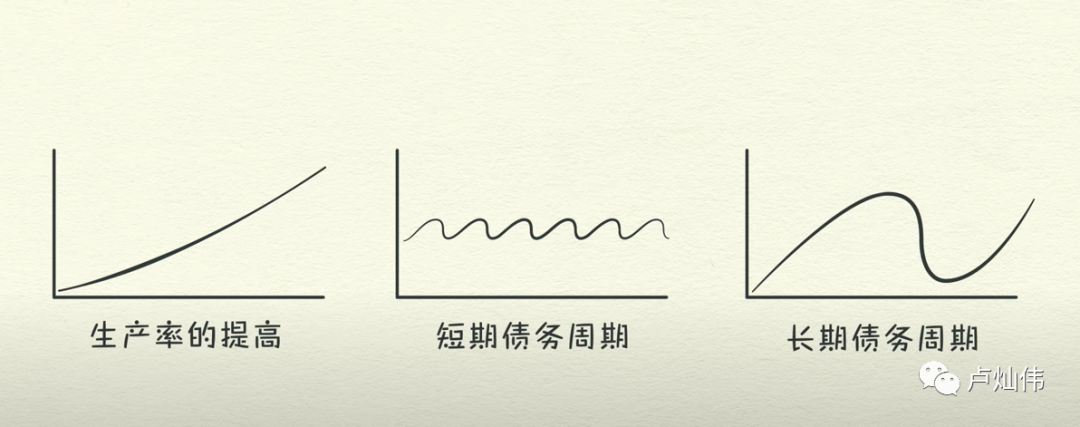
Although the economy seems complex, it is made up of individual transactions. These transactions form three main economic drivers, as shown in the diagram below:
So how do we understand transactions? For example, if you use cash to buy a bottle of cola, that is a transaction. You can also use a credit card to purchase cola; that is also a transaction. Of course, you can buy real estate, stocks, a haircut, and so on.
Transactions involve the exchange of goods, services, and financial products through money and credit.
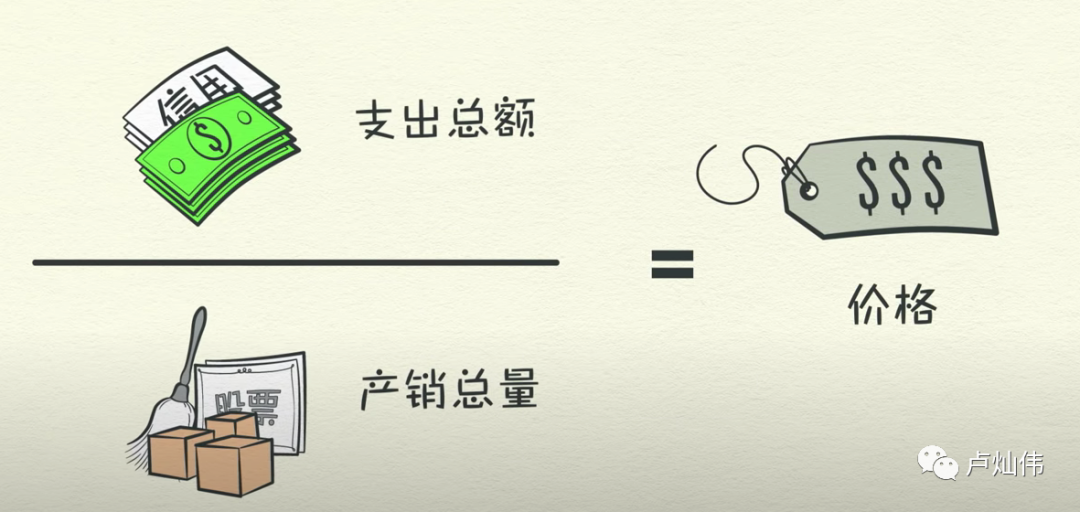
Money + Credit = Total Expenditure, which is how much you spent. If you divide this by the sales volume (how many items you bought), you get a price, as shown in the diagram below.
This is what a transaction is; transactions occur in different markets. For example, you can find transactions in the vegetable market, car market, housing market, stock market, etc. The collection of all these markets allows us to understand all the information in the economy.
Individuals, banks, businesses, and governments are all engaged in various transactions. The government is the largest buyer and seller, divided into two parts: mainly collecting taxes and spending, which includes the central government and the central bank (commonly referred to as the central bank). The central bank controls the quantity of money and credit, adjusting interest rates and printing money to implement economic adjustments.
Credit is the most important part of the economy. For example, if Xiaoming wants to buy a computer and uses a credit service to make the purchase, it is equivalent to Xiaoming borrowing money from the bank. When interest rates are high, fewer people borrow money; when interest rates are low, more people borrow money. If borrowing 1,000 yuan has a real interest rate of 14.94%, it means I need to pay back 149.4 yuan in interest in a year. If I pay it back during the interest-free period, there is no interest, and many people are willing to borrow.
In this way, the bank acquires a credit asset, while Xiaoming has a debt that needs to be repaid at some point. When Xiaoming repays the money, these assets and liabilities will disappear. These expenditures that appeared out of nowhere will become someone else's income, and then our GDP will rise, forming an economic cycle.
If Xiaoming uses the computer for programming and increases his income, that is an improvement in productivity. However, if he uses it to play games and spend money, then his productivity does not improve, and his expenditure exceeds his income. If we all improve our productivity, the increase in income will also turn our expenditures into someone else's increased income, creating a virtuous cycle.
However, because we borrow money, cycles will occur. For example, during the Double Eleven shopping festival, if we buy a lot with credit, we may struggle to pay it back next month. We have overdrawn our future income, and when we finish repaying the money, we can only live frugally, meaning our expenditures decrease. When expenditures decrease, someone else's income also decreases, leading the economy into a downturn.
Most transactions in the market are credit-based, while cash transactions account for less than one-tenth of credit transactions.
When the amount of expenditure exceeds the production of goods, the money in the market increases, but the efficiency of producing goods remains the same, which will raise the prices of goods and cause inflation. This is why printing money makes things more expensive. When inflation is too high, many problems arise. For example, in Venezuela and Zimbabwe, people have to carry large bags of money to buy a bottle of cola. If inflation continues to rise, the money may not even cover the cost of printing the paper.
Therefore, the central bank does not want inflation to be too high, so it raises interest rates to make borrowing more difficult. Originally, I could borrow 1,000 yuan without paying interest within 30 days, but now I have to pay 149 yuan in interest, which discourages many people from borrowing, leading to a decrease in the money circulating in the market, and thus entering a period of deflation.
Our nature is to prefer to gain without effort; money borrowed based on ability is certainly not something we want to repay.
As borrowing increases, the money in the market grows, leading to a more prosperous period where asset values continuously rise. For example, in a situation where everything you buy appreciates, there is too much money in the market, and everyone is buying, leading to increased expenditures and incomes. Despite having a lot of debt, asset values keep rising. For instance, if you buy a house with a mortgage and the housing prices soar, you may feel very wealthy.
When the interest on debt starts to exceed your income, you can only begin to tighten your belt to repay the debt. This will also lower someone else's income, forcing them to tighten their spending to repay their debts, leading to a reduction in credit. People find it hard to borrow money but still have to repay, and then the bubble will burst.
Next, everyone enters a period of deleveraging, where people tighten their belts and cannot borrow more money but still have to repay. They can only sell houses or stocks. When there are many people trying to sell assets in the market, the value of those assets will rapidly decline, and stock and housing prices will fall.
Everyone becomes very poor. Although it was mentioned earlier that the central bank can control this through interest rates, interest rates are already very low and cannot go lower, approaching zero. So what can be done at this point when borrowers cannot repay?
There are four ways to alleviate debt:
The first three methods will lead to deflation, while printing money will cause inflation. As long as the balance is maintained, deleveraging can be harmoniously achieved, allowing the economy to smoothly navigate the downturn.
Finally, three rules:
If you still don't understand after reading, you can search online for the video "How the Economic Machine Works" for better understanding.
Recommendations:
How important are right and wrong?
What's so difficult about this?
How to recruit a reliable person outside our professional field?
How are our decisions influenced by external factors?
Besides you and me, is there a third option?
Seeing through the essence of things.
Scan the code to follow 【Lu Canwei】, and send "self-media materials" in the background to receive two benefits for free:
1. A self-media tool package (worth 1,999 yuan).
2. An electronic version of the "2020 Wealth Calendar," containing 365 money-making tips.
👇👇👇 Feel free to click to follow~
"Looking" is the strongest support ↘