9 min read
"How to Eat from the Bowl, Look at the Table, and Think of the Kitchen?"

This article is Lu Canwei's 146th original piece.
Click the blue 【Lu Canwei】 above to follow; remember to add a ⭐️ star mark~
Recently, a concept has been discussed, called "eating from the bowl, looking at the table, and thinking about the kitchen." If we apply this to romantic relationships, it’s a clear warning sign of a scumbag. But what about in the context of businesses?
Microsoft and Apple
I wonder if everyone has been paying attention to Microsoft. After experiencing a complete failure in the mobile sector, it recently climbed to a market value of $2 trillion, taking only two years to go from $1 trillion to $2 trillion.
This achievement is largely credited to an Indian-American, Satya Nadella. For many in the tech field, Microsoft was extremely closed off in its early years, essentially a fierce rival to the open-source operating system Linux. Moreover, early Microsoft was exclusive; you would hardly see any Microsoft products on iOS, iPads, or Macs.
The first thing he did upon taking office was to transform Microsoft from a closed system into an open one, embracing openness. He first made Office and Windows more open; for example, you can now see Office on Apple's systems, and Windows actively integrated with Linux, creating a subsystem called WSL.
Another area is cloud services. In the second quarter of the 2021 fiscal year, Azure's revenue was $7.2 billion, accounting for 17% of Microsoft's total revenue for that quarter. Its revenue has surpassed that of Office, becoming Microsoft's largest source of income. Additionally, Microsoft increased external investments, acquiring LinkedIn, GitHub, and others, and has now become one of the most active companies in the open-source community.
The other company is Apple, which everyone is quite familiar with. However, since Steve Jobs passed away, we have seen more of Apple's sales continuously expanding rather than Apple leading another industry revolution.
Tim Cook's background is rooted in supply chain management, focusing more on costs and inventory. As mentioned in "The Tim Cook Biography," Apple's original supply chain was extremely poor. After Cook arrived, he significantly reduced the inventory across the entire supply chain through meticulous forecasting and monitoring at each node, greatly lowering Apple's costs. This reminds me of another company that grew large through its supply chain: 7-11.
However, it is currently hard to see Apple leading an industry revolution; it seems more like they are following trends. From the news in the market, it can be basically confirmed that Apple is also venturing into car manufacturing. Yet, the person leading the revolution in the automotive industry is Elon Musk.
Life Curve
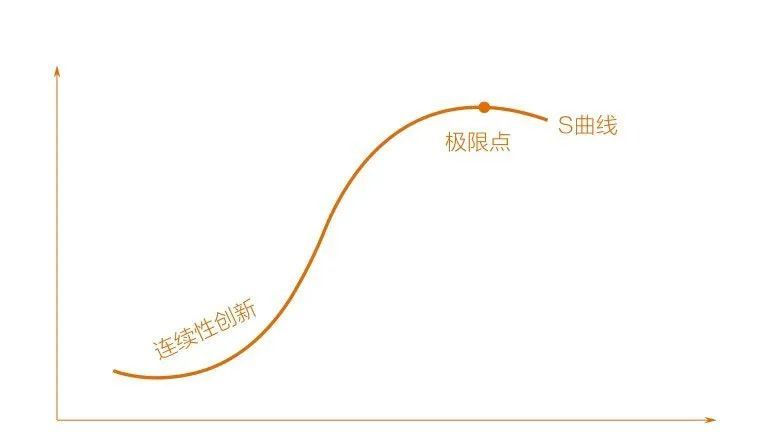
In most cases, the patterns of businesses resemble the graph below, assuming the business hasn’t died. Of course, most businesses may not survive to see the next peak and end up closing down.
Both Microsoft and Apple have experienced such a curve structure. For instance, after Steve Ballmer took office, Microsoft stubbornly focused on selling Windows systems, creating a multitude of system versions, which led to fragmentation in the system versions. This caused issues in the developer ecosystem, as developers were unwilling to help with adaptations, while next door, Apple's system upgrades and iWork were free.
We can understand that during this period, Microsoft was essentially moving from halfway up the mountain to the bottom. At this time, the peak for the company was the glorious moments created by the early Windows system and Office. However, with the development of the times, the dividends from this strategy have begun to fade. Choosing to stubbornly stick to this strategy or continue selling software clearly has become unfeasible. In contrast, domestic company Xiaomi has begun to become a giant by selling services.
The first thing Nadella did upon taking office was to fully transform into cloud services. Rather than slowly dying, it was better to pivot. The entire cloud service industry has entered a sunrise period. If one had entered this dawn period earlier, say a decade ago, it might not have been possible to succeed.
Amazon has already validated this in the cloud service sector. When entering an industry in its sunrise period, although one may not get the biggest piece of the pie, they also do not have to bear the significant risks of the industry's development.
Another aspect is openness and collaboration. Transforming from a closed company into an open one, another company that is quite familiar is Tencent. After the 3Q War, Tencent began to evolve into a different company.
Through this series of reforms, Microsoft successfully moved from the bottom of the mountain to the next peak. So, is our life similar? Most people experience ups and downs, and many experience significant highs and lows. During the lows, how many people are still living off past glories? Or do they choose to achieve new accomplishments?
We also see many companies that continue to thrive, seemingly exceptionally lucky, never going under. Take Intel, for example, the chip giant in your computer. But did you know that Intel originally made memory products, specifically hard drives, and had a 100% market share in 1969?
However, the good times didn’t last long. Japan, with national support, fostered six memory companies, and after ten years of dedicated development, they completely surpassed the United States. At this point, if you were the owner of Intel, what would you do? Would you continue to compete head-on with Japanese companies in memory? Don’t rush to answer; there’s a saying that it’s hard to go from luxury to frugality.
Then, two prominent figures within Intel, who were not ordinary people, managed to lead Intel into a new growth curve instead of falling to the bottom before reforming.
Since I will eventually be killed, why not commit suicide first and then be reborn?
Another company invented the digital camera but could not abandon its main business of film, preventing it from entering the second curve. This company is Kodak.
Of course, many companies that entered the second curve ultimately collapsed under it. For instance, the second season of "The Naked Director" I recently watched tells the story of an AV king who hoped to transform the company into satellite television, only to end up destroying it.
Aside from the personal issues of the CEO, more importantly, satellite television was still in its dawn period at that time, while the CEO completely abandoned the first curve's business and went all-in on the new venture.
Just like hydrogen fuel vehicles and electric vehicles were considered different technological iterations a few years ago, Musk also went all-in at that time, nearly leading himself to bankruptcy, but ultimately, electric vehicles emerged. Most companies tend to bet on both sides, while there are steadfast companies like Toyota that firmly bet on hydrogen energy.
The second curve may succeed or fail, but everyone tends to retroactively judge the decisions made at that time as wrong based on the final results. However, regardless of which path is chosen, it is better than living off past glories. Once successful, there will be at least a tenfold growth.
While we enjoy the dividends of past legacies, we must also consider our own second curve; otherwise, we may face the risk of closure.
Thoughts and Philosophy
Earlier, I mentioned that when you are still enjoying the dividends from years ago, it may be because you chose the right university and major many years ago, or you graduated into a promising industry, etc. This behavior is akin to eating from the bowl.
The second curve represents what we see on the table, the dishes we can observe, such as the developing fields of AI, deep learning, the Internet of Things, vehicle networking, 5G, brain-computer interfaces, space exploration, and so on.
So, what does thinking about the kitchen mean?
Before the Qin Dynasty unified the six states, the shapes of coins varied, such as spade coins, knife coins, and ring coins, and they could only circulate within their respective jurisdictions. This feels somewhat similar to the current European Union, where each state belonged to China but had its own currency and governance. Then, laws, measurements, and scripts were unified, making the nation truly one.
This laid the foundation for Chinese culture, leading to a return to unity over the next two thousand years, even after periods of division. What the Qin king saw was a future that transcended eras.
This is a kind of thought, which can also be called a philosophy.
How do we establish it?
It’s like we have countless neurons in our brains. When the brain begins to think about something, it first activates a portion of the neurons, then links them to other different neurons, continuously activating them, ultimately forming a region.
If I consider my studied major as a neuron, then, for example, I am in technology, operations, product, business, sales, and other fields; our professional knowledge is our neuron. However, a single neuron cannot process too much data; it can only think about the present, meaning the knowledge within our professional expertise.
Thus, the judgments we make are akin to eating from the bowl, only considering whether the food in the bowl is good or not, or whether to add some soy sauce for a soy sauce rice dish. When we learn other scientific knowledge, we realize that we don’t necessarily have to eat rice; we can also eat noodles. This is where the second curve that everyone can see emerges.
As we learn more subjects, we generate a new thought. For example, there is a special dish in Chaoshan called fish noodles, made from fish meat. Different subject contents can create some chemical reactions.
Why did the iPhone create the mobile internet industry and usher in the era of smartphones? Were there no handheld devices before the iPhone? There were, such as the company Palm, which many of you may have heard of. However, they were making handheld devices that were not phones, more like a larger touch version of a Wenquxing (a type of electronic dictionary). But the iPhone created the App Store, allowing developers to upload their own apps. So, is the App Store a new thing? Not really. I believe many of you used to enjoy downloading software from various software parks, right?
Reformers understand the problems with existing knowledge and, after considering various methods, come up with a new solution. Was battery technology available before? Yes, but it was large and expensive. So Musk directly assembled single-cell batteries and unified scheduling through software, significantly reducing costs and leading to the rapid development of the electric vehicle industry.
In conclusion,
Changing one's mindset is often the most difficult part. Only through continuous learning and constant activation between neurons will you discover patterns, which is what we refer to as the Dao.
Humans are inherently good at summarizing and generalizing.
Recommendations:
Feeling more and more discouraged despite working hard? It might be because you haven't mastered the right approach.
The harder you work, the luckier you get? Take a look at the story of this 71-year-old supermodel.
The success of most projects comes from finding the right users; user persona analysis is more important than you think.
It's been 100 days, let's say something.
Scan the code to follow 【Lu Canwei】, and send "self-media materials" in the background to receive two benefits for free:
1. A self-media tool kit (worth 1999 yuan)
2. An electronic version of the "2020 Wealth Calendar," containing 365 money-making tips;
👇👇👇 Feel free to click to follow~
"Watching" is the strongest support ↘