6 min read
"How to Improve Cognition?"

This article is Lu Canwei's 26th original piece.
Recently, I haven't written an article for a while. These past few days, some fans specifically told me that they really enjoy my articles. I realized that it has indeed been a while since I last updated, so I will try to maintain a weekly update rhythm in the future. I hope everyone can support me more, so I can earn a living soon.
I understand cognition from two aspects: the first aspect is self-cognition, and the second is external cognition. Self-cognition is essentially the decision-making framework formed by the breadth of one’s knowledge and the organization of diverse information, while external cognition mainly involves going with the flow and doing the right thing at the right time.
I
Or to put it another way that everyone can understand better: as the saying goes, as long as you are on the right trend, even a pig can fly.
Of course, no one wants to be a pig, but stories of turning the tide against the wind are mostly seen in games and comics. Let me share an example I recently came across, about Coca-Cola.
The Story of Coca-Cola
Although I don't drink Coke much anymore, what I want to talk about is the story of Coca-Cola. The history of Coca-Cola can basically be compared to the history of the United States. In its early years, Coke was primarily marketed as a health drink, with claims that it could cure all ailments, which was common for many health drinks of that era. The reason so many health drinks emerged during that time was due to Prohibition. Thus, Coke, which contained sugar and cocaine and could induce dopamine highs, began to gain popularity, even though it was initially created by a crazy pharmacist looking for a substitute for his morphine addiction. This was the first trend that Coca-Cola capitalized on.
Subsequently, the advertising industry in the United States began to rise, and Coca-Cola blossomed across the country, with its handwritten logo becoming unavoidable for Americans no matter where they looked. Currently, Coca-Cola is not without its challenges; it has been dealing with various lawsuits, ownership disputes, and conflicts with bottlers. It’s worth mentioning that the Coke we drink is actually bottled by local bottlers; Coca-Cola Company primarily sells syrup, maximizing profits while transferring the heavy asset risks to the bottlers. This is also a reason for Coca-Cola's rapid development. Coca-Cola rode the wave of advertising to sell across the United States, marking its second trend.
At this point, I must mention its rival, Pepsi. In its early days, Pepsi was on the brink of bankruptcy and wanted to sell itself to Coca-Cola, but Coca-Cola responded that it was worthless, just like other knockoff colas, and questioned why it would buy garbage. Later, Coca-Cola continued to push forward, supplying Pepsi with wave after wave of talent, which eventually allowed Pepsi to start eroding Coca-Cola's market share.
As the United States entered World War II, Coca-Cola began to set up bottling plants worldwide alongside the U.S. military. At that time, Coca-Cola issued a special order: "No matter where the U.S. military is, regardless of the cost to the company, we must ensure that soldiers can buy a bottle of Coca-Cola." There was even a story that when pilots found their planes unable to take off, the first things to be jettisoned were "guns, jeeps, and ammunition," but they would never throw away a bottle of Coca-Cola. Moreover, prisoners of war were prioritized for work in Coca-Cola plants. The war allowed Coca-Cola to sell worldwide, with Icelanders consuming more Coke per capita than any other country, marking Coca-Cola's third trend.
It should also be noted that Coca-Cola's German branch expanded alongside Hitler's army. Since Coca-Cola was a foreign company, when Britain and France declared war on Germany, there were concerns that Coca-Cola would be "nationalized," leading to the birth of the locally registered "Fanta."
Later, Coca-Cola continued to expand globally, following events such as changes in U.S. presidents, the global village concept, and the Beijing Olympics. Whether it was Tencent born from the need for communication, NetEase from the emergence of email, or Alibaba from the rise of e-commerce, none of them were not riding the wave of the times.
You may have heard of the Gatling gun, but did you know that its inventor, Gatling, was a doctor? He wanted the war to end quickly to reduce casualties, so he aimed to reduce the number of soldiers, which led to the invention of the Gatling gun.
Thus, at the right time, we need to do the right thing, rather than just doing whatever we can.
II
Having discussed going with the flow or finding the right trend, we must ask: when the trend comes, can we take off? If we do take off, will we crash when the trend fades? At this point, we need to arm ourselves and enhance our knowledge reserves and cognition.
Recently, I came across a saying: "The brain is for thinking, not for memorizing."
So I comfortably lay on the sofa sipping milk tea.
Of course... not...
If my brain isn't for memorizing, then where do I store things?
At this moment, I remembered the Evernote I used before, which I couldn't distinguish between the international and domestic versions, and the things I captured had display issues, possibly due to my improper usage. Later, I switched to Bear, but it only had simple Markdown and tagging functions, which couldn't meet the needs for building a knowledge system, until I discovered Notion, although the learning curve for this tool is a bit steep. But tools are just tools; the main focus here is on establishing a framework for a knowledge system. These are organized from a large number of articles that I found suitable, but habits still need to be cultivated gradually.
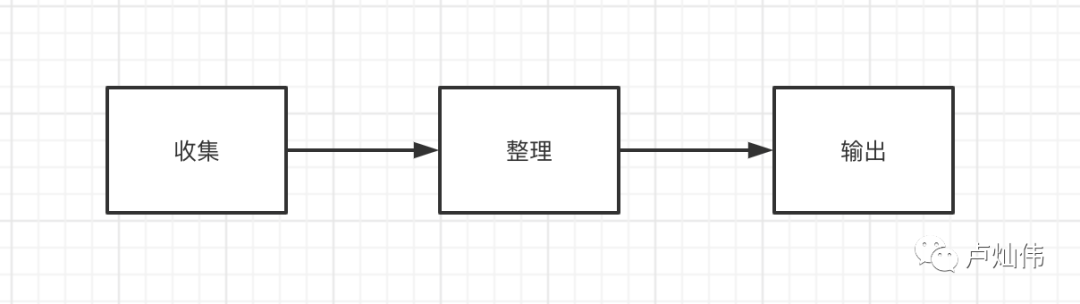
The process can be simply divided into three steps:
Collect
Information is mainly divided into three categories: fragmented information, systematic information, and ideas and inspiration. All of this information will need to be processed later.
Organize
This process involves secondary processing of the information, specifically targeting the three categories mentioned above.
Output
As for how I use Notion to accomplish the above tasks, interested friends can leave a message. If there are enough people, I will write a separate article to explain how to use Notion and how to establish a knowledge system with it.
III
Having discussed waiting for opportunities and arming ourselves to avoid missing them, why do we need to go through the trouble of establishing our own knowledge system? Aren't top students born that way? If you can't remember, then you can't remember.
Actually, I used to think this way too, after all, I was a poor student and didn't attend school for long.
While searching for articles on knowledge systems, I unexpectedly discovered a treasure. A content creator ( @YJango ) was analyzing the underlying framework of learning, and I was instantly hooked, spending an entire night binge-watching all of his videos.
Forgetting is for better learning.
He mentioned a fundamental principle: there are two types of memory—lookup memory and network memory.
The brain's underlying memory is network memory, which is why we can handle unknown situations while machines cannot. Learning is about finding patterns in known situations that predict unknown situations; this pattern is called knowledge at the conscious level and is more generally referred to as a model. This is also what distinguishes humans from other living beings.
So why do we forget? Because you cannot guarantee that the patterns your brain finds are applicable to all situations; they may only be local patterns. If the brain does not choose to forget based on usage frequency, it becomes difficult to limit the emergence of local patterns, leading to an inability to accept new patterns.
Thus, the efficiency of lookup memory in network memory is very low, and we have the forgetting curve, which is why we need a place to help us record and retrieve memories.
Recommended Reading
Let's talk about interviews and recruitment.
Should technical managers become technical experts in their teams?
How to define the value your product creates for users.