11 min read
"How to Start a Business Without Resources or Connections? This Book Will Help You Avoid Pitfalls"




If it weren't for the recommendations and reviews, this book might have been overlooked just because of its title. In fact, the programmer community tends to focus on just one more programmer, which reflects the helplessness and bitterness of programmers, waiting to be harvested like well-grown leeks.
So can programmers start their own businesses? Many programmers do not fail technically but fail in product, market, finance, taxation, and team management.
As I mentioned in a video yesterday, one type of entrepreneur is the technical entrepreneur. They may have strong technical skills but still fail. The reason is that when you think these things are simple, you want to do everything. Moreover, you pursue technical perfection and comprehensive design for each feature. This leads to spending a lot of time building something in isolation. When it finally goes to market, you find that users are not interested.
I have been thinking about whether there are lower-cost ways to start a business. Later, I came across the book "The Lean Startup," which discusses how Dropbox got started, and it sounds like a smooth journey. I followed the methods outlined in the book step by step and began my first entrepreneurial venture.
However, as I tried some of the methods mentioned, I found that it was not as smooth as described. In communicating with users, providing prototypes, and during development and usage, you will find that users who initially expressed a willingness to pay disappear when you finish the product and want them to use it. This is a common problem that entrepreneurs face.
I could write a piece about the dramatic situations I encountered during my first startup, but I won't elaborate on that today. Until I saw the book "Run, Programmer," my long-standing confusion was finally resolved.
Why Start a Business
The author explores in the book why one should consider joining a startup or even starting one’s own. The book mainly focuses on tech startups.
What is a tech startup? If a company's business development primarily relies on technological research and development, whether the technology is for actual products sold or for selling other products, then it is a tech company.
For example, Ctrip sells travel products, but to achieve this, most of its employees work on technology development, such as apps, user accounts, review storage, recruitment storage, and search functions. A restaurant, even if it has its own app and mini-program, cannot be considered a tech company because it provides dining services rather than technology services.
Should You Work in a Startup?
If you want to work in a startup or even establish such a company, we should consider three main factors: more opportunities, more ownership, and more fun.
More Opportunities
Nowadays, we can send messages and contact friends via WeChat, watch videos on Bilibili, and follow celebrity updates on Weibo, all with just a smartphone. It enhances our communication skills (e.g., video, phone, text), memory (e.g., reminders, alarms, recruitment), sense of direction (various map apps, GPS), provides more entertainment (music, games), and more information (various news apps). In ancient times, we might have been considered superhumans.
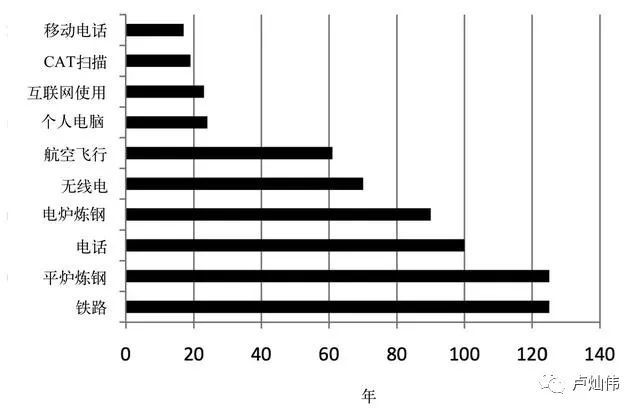
The chart above shows the number of years required for specific technologies to achieve 80% coverage. As you can see, the internet, personal computers, and mobile phones have only been around for about 20 years. New technologies are spreading rapidly, and this time will surely shorten in the future.
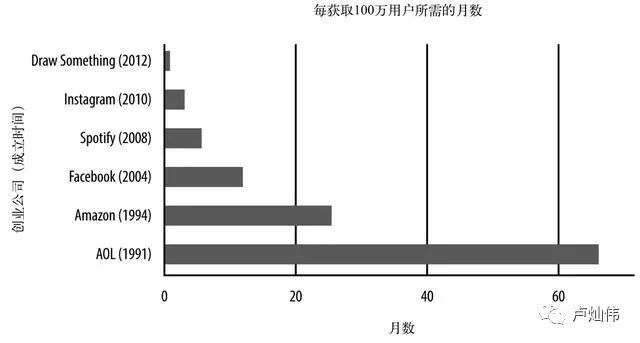
Today, the speed at which startups reach a billion dollars is twice that of the year 2000. This is not due to a bubble but because it is now easier than ever to establish and grow a company. The chart shows the number of months it takes to gain 1 million users.
We can now build our projects using a wealth of open-source technologies and connect our businesses with various third-party services without starting from scratch. We can promote our products through many public channels and have access to abundant venture capital, placing us in an unusually favorable historical period.
More Ownership
So why not write code in a mature large company? There are no longer any iron rice bowls. Statistics show that people born in the 1960s will typically hold 11.3 jobs between the ages of 18 and 46, and this number may continue to rise. For those born in the 1980s, the average is 6.2 jobs by age 26. From the first number, we can calculate that the average duration of a job is less than three years.
Moreover, large companies are not stable. Companies like Oracle have exited the market, and firms like NetEase, Tencent, Alibaba, and JD have laid off employees, as there is no such thing as a stable job anymore. The real risk is not losing your job by joining a small startup; after all, working in a large company does not guarantee job security, but rather the risk of losing opportunities.
So when you feel there are no opportunities to move forward, you should leave quickly, as you may be missing out on better opportunities.
In larger companies, your success or failure often depends on the team you are in. If upper management believes the team's work is strategic and aligns with business goals, they will care about when you can generate revenue and similar matters. Even if your team is excellent, if there are serious issues with your strategy and direction, your project will still fail. Conversely, if your strategy is correct, even a poor team can succeed.
This is why people say that the so-called "big company syndrome" is not due to the size of the company but rather that some issues have long existed within the team, only covered up by the success of the project. Working in a small company usually grants you more autonomy, allowing you to have a greater say in what to do, when to do it, and how to do it, without excessive red tape, bureaucracy, and political struggles.
Starting a business can also give you more control. In a startup, you will face various tasks and often need to learn new things on your path forward.
More Fun
A slum-like office, having to tighten your belt to make ends meet, and often feeling lost about what you are doing can be frightening, but it is also exhilarating. Just like now, feeling a bit high but not knowing what is right or what you are doing, yet solving problems always brings joy and a sense of progress.
Why You Shouldn't Work in a Startup
While I have praised startups, entrepreneurship is not as glamorous as it seems; it requires many sacrifices and may not lead to wealth. I have experienced many startups, most of which ultimately failed. I have even been nicknamed "the Grim Lantern."
Entrepreneurship is 99.9% difficult and not at all romantic. While others are watching TV, you are deploying code; while your friends are out partying, you are still frantically coding to fix bugs, as these are the nights before product launches.
Facing competition from large companies, it is hard to recruit outstanding talent. When the talented individuals you finally manage to hire decide to leave, it can feel like a harsh reality; firing underperformers is also difficult; motivating people is equally challenging; when things are not improving and money is running out, motivating yourself becomes even harder; securing funding is tough; after investors come on board, keeping them from steering your business off course is also difficult; when you have to worry about the company's short-term survival, focusing on its long-term development direction is challenging; getting a constantly changing market to accept a brand new product is tough.
You should not expect to get rich through your salary. Most startups offer salaries below market rates in their early stages, so joining a startup actually carries the risk of earning less money.
You should also not assume that being an early employee will lead to promotions to higher positions (like CTO or Vice President) to make up for previous losses. This is because in the early stages, you face long working hours, rapidly changing demands, and tight deadlines, making it nearly impossible to produce high-quality software.
In short, hoping to get rich by joining a startup is not a wise move. Many people wish to join the next ByteDance or Alibaba, but in most cases, you will be drained and then discarded.
On average, it takes seven to eight years to successfully exit (e.g., through acquisition or IPO). Of course, for investors, it really is just about "exiting," while founders typically stay for several more years. Therefore, one rule of thumb we can derive is that only if you are willing to spend the next decade of your life building a company can you pursue this endeavor.
Startup Ideas
Where do ideas come from? They usually arise from imitating, transforming, or merging existing ideas, which is what people refer to as micro-innovation. The best way to come up with new ideas is to learn a large number of old ideas. If it’s just like compound interest, the earlier you invest, the better.
Starting today, think of every possible way to begin learning and strive to become a T-shaped person. A T-shaped person is someone who is both a generalist (highly skilled in many valuable areas—the horizontal part of the T) and a specialist (one of the best in a specific field—the vertical part of the T).
So what kind of environment can inspire people to generate new ideas? Common elements include these:
When I decided on my next decade, I didn't know what I should do, so I kept writing articles analyzing various industries and recording ideas through a to-do list.
Most people fear being mocked for their ideas and are also afraid that others will steal their ideas. But if you are afraid of failure in a startup, you are destined to fail. Making mistakes is an essential part of learning, and in some cases, it is the only way to learn. Worrying about someone plagiarizing your ideas is generally not a reasonable concern; most people are not interested in stealing startup ideas and taking them away to turn them into their own companies—because they are either too lazy or too busy.
Do not be afraid to validate your ideas. Just like Edison, who tried thousands of materials for filaments and, after failing, said he discovered ten thousand ways that didn't work. Most of the companies you know are quite different from what they did when they first started.
The ideal situation for most product development is as shown in the diagram below:
But most situations are as shown in the diagram below:
So if you are starting a business, make sure to stick with the later curve and do not give up during the trial-and-error phase. As I mentioned earlier, it can be achieved through lean/agile methods.
Using lean/agile methods allows for rapid trial and error, but it still cannot quickly jump out of the trial-and-error phase; it just lets you run a little faster.
We can understand users' true needs through the "Five Whys." When you ask the fifth "why," you are basically close to the real reason (usually, my process doesn't go that smoothly; by the second "why," everyone loses patience, much like trying to trim your cat's nails).
What we need to consider is feasibility. Whether it can solve a problem depends on two factors.
The questions we need to consider are:
"Why now?" What has changed in the world that makes now the best time to establish this company? What do you know that others do not? Why didn't anyone establish such a company two years ago? Why would it be too late to establish such a company two years from now?
Data and Marketing
Basically, all companies need to track these types of metrics:
I won't go into detail about the above; everyone is clear on that. The last one is the so-called magic number. This represents the number that indicates user engagement with your product.
For example, for Facebook, the leading indicator for new users becoming highly engaged users is the "magic number" of "contacting 7 friends within the first 10 days of registration."
For Twitter, a new user is likely to become an active user after following 30 people.
In Slack, once a team exchanges 2000 messages, 93% of them will continue to be Slack users.
Common marketing channels for startups:
Word of Mouth
1. Create a better product; your product needs to be differentiated. For example, if you see a dog while driving, you might not pay much attention because they are everywhere, but what if it’s a purple dog?
2. Provide excellent customer service; many startups rotate employees through different positions.
3. Create a viral loop for the product; early Hotmail would include a line at the bottom of emails stating that the email was sent from Hotmail.
Marketing
Sales
Branding
Here, the example of Red Bull is mentioned. Red Bull operates a Red Bull TV channel that broadcasts extreme sports such as skydiving, parkour, ice climbing, and white-water rafting; it has several sports teams, including New York Red Bulls (soccer), Infiniti Red Bull Racing (Formula 1), and Team Red Bull (NASCAR); it also sponsors events like the Red Bull Road Rage (extreme downhill biking competition), Red Bull X-Fighters (freestyle motocross stunt competition held in bullrings), and Red Bull Stratos (a space jump project that included skydiver Felix Baumgartner, who free-fell from 38 kilometers high at a speed exceeding 1280 kilometers per hour). So when you think of Red Bull, you think not of the drink but of extreme sports—that is its brand.
Also, regarding the iPod, during the era when the iPod was born, most people were listening to CDs, with about 12 songs per CD. The idea of a pocket-sized music player that could hold 1000 songs was enough to attract global attention.
Finally,
I have only extracted a major part of the book that describes products in depth. For startups, how to take a product from 0 to 1 and validate it, as well as how to market it, is particularly important. The following chapters mainly cover technology and teams, which are also significant topics. It cannot be fully described in a single article. Interested friends can read this book themselves.
To quote the answers to the questions "Who is Apple?" and "What does it represent?"
May you not give up, persist, and truly change the world.
愿你不要放弃,坚持下去,真正去改变世界。