11 min read
"Is Joining a Paid Community Worth It? You Might Have a Different Perspective After Reading"
This article is Lu Canwei's 112th original work.
Click the blue 【Lu Canwei】 above to follow; remember to add a ⭐️ star mark~
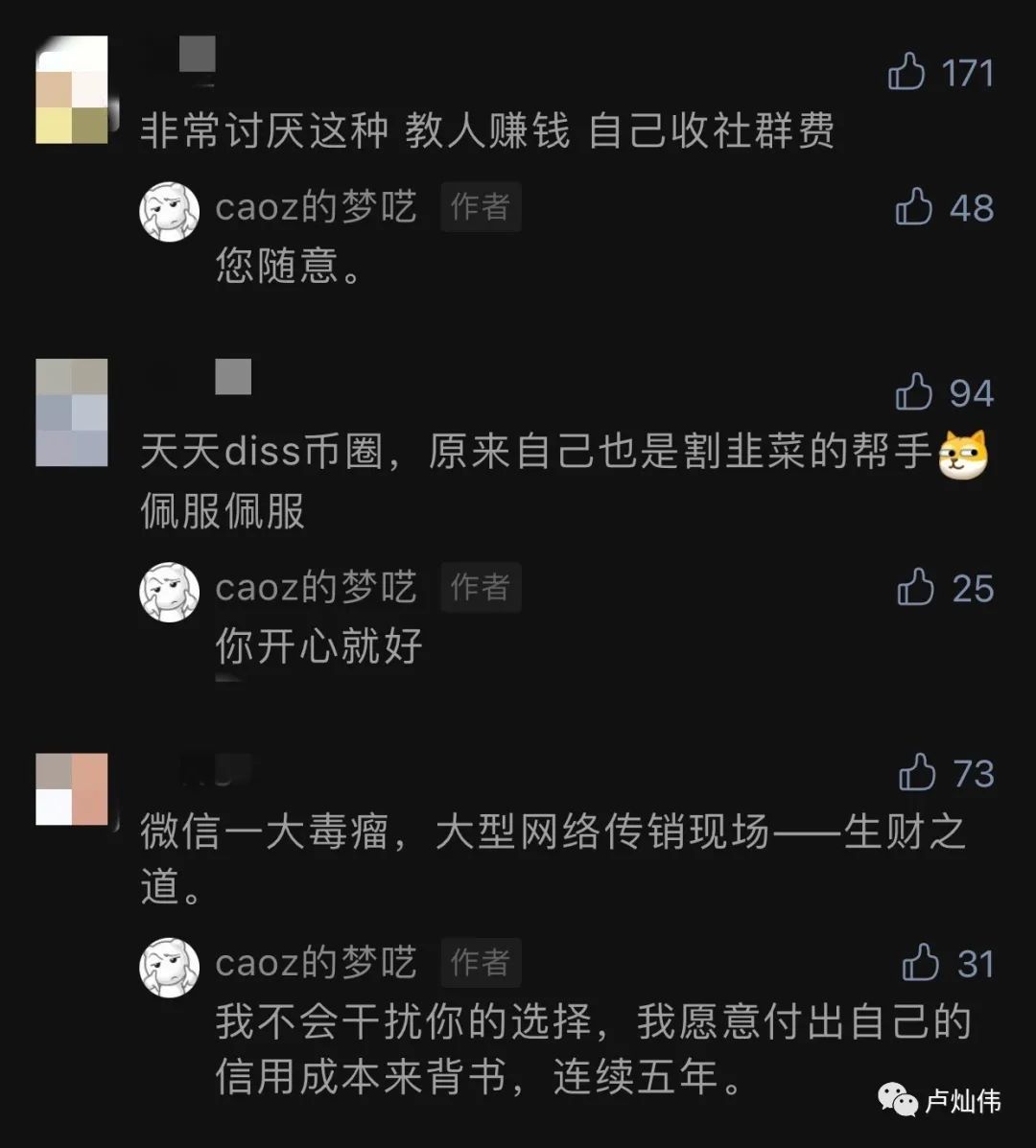
Last night, I saw a post from Cao Da. I thought that a big shot recommending a paid community would have a very good effect, after all, even my own posts in Moments get dissed. But then I saw the comments, and it was a slap in the face—every highly-rated comment was criticizing it. After reading the whole article, it was full of valuable content. This article has nearly 30,000 reads, and if we calculate the advertising cost at 1 yuan per read, then this article could earn about 30,000 yuan from ads.
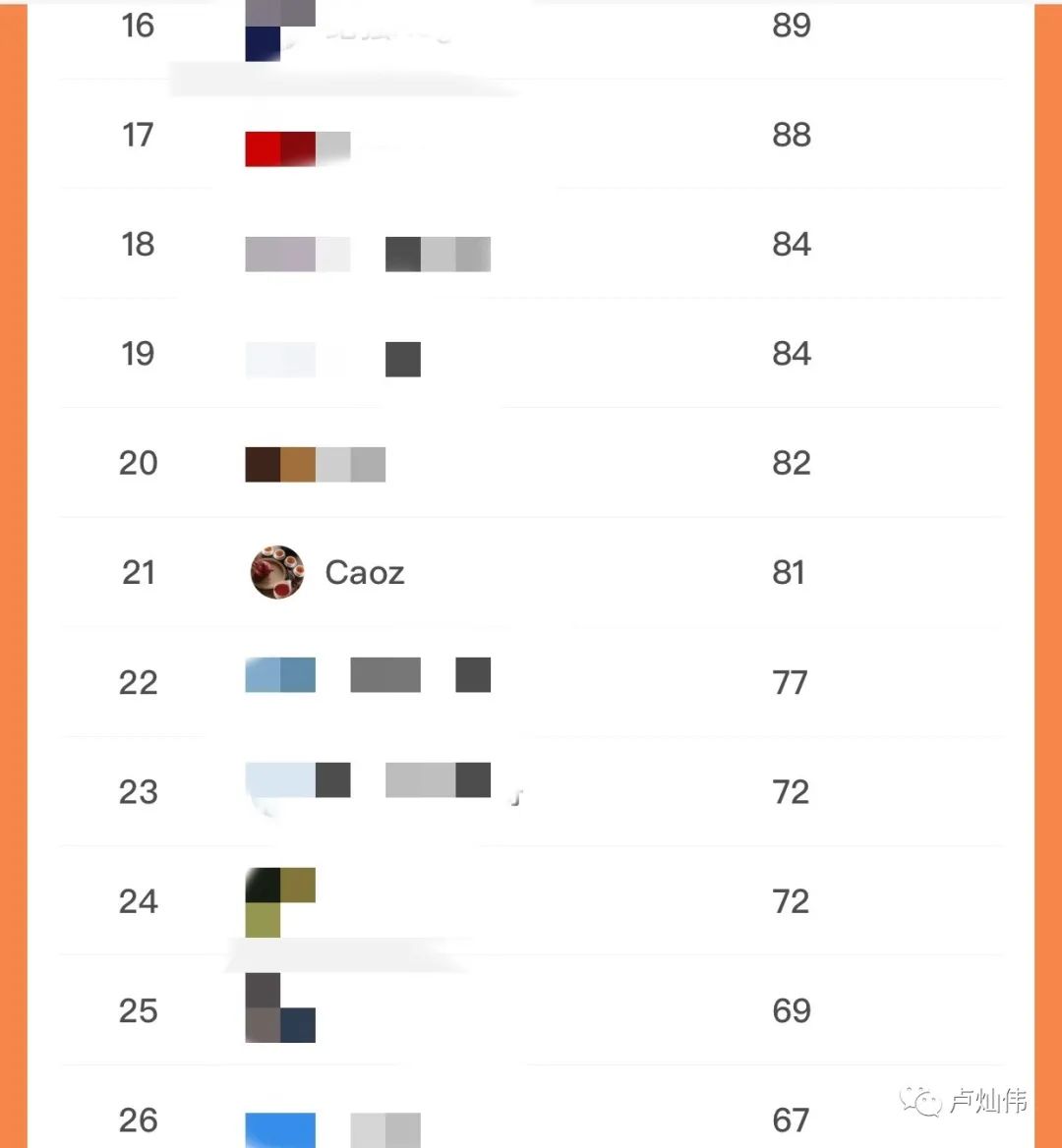
Currently, the number of people making money has exceeded 30,000. According to the fourth phase, there were over 17,000 people, and now the fifth phase has over 30,000 people. If we assume that old members renew at a 100% rate (of course, this is a hypothesis; if the renewal rate is below 100%, then new users will only increase), then there are over 13,000 new users. The current ticket price is 2,565 yuan, with a starting price of 1,565 yuan. Let's take an average value of 2,000 yuan. Based on a commission rate of 10%-20%, we will also take an average of 15%. We also found that Cao Da brought in 81 new users by the deadline of April 19 at 2 PM.
So, Cao Da's earnings from helping to bring in new users would be: 2000 * 81 * 15% = 24,300 yuan. So why not just take a commercial advertisement directly? First, it doesn't require writing over 4,500 words; producing such an article takes at least over 2 hours. Second, using one's own credibility as a guarantee, the value of that is certainly far greater than this commission.
Of course, the data above is based on information I could gather from existing sources. Even if we don't consider Cao Da's recommendation, we should think about why over 13,000 people are willing to pay an average of 2,000 yuan to join a community. Are they all fools?
The Value of Products
The value of a new product often depends on the reference comparison it is based on. When an unknown brand appears, we often look for existing information in the market as a reference. For example, when Xiaomi phones first appeared, there were already Apple phones, Android phones, and counterfeit phones, each occupying the high-end, mid-range, and low-end markets. At that time, Xiaomi advertised that you could buy a mid-range product at a low-end price, and when everyone compared, they thought, "Wow, that's a great deal."
The same applies to paid knowledge; there is a vast amount of knowledge content available on the market. I can buy a ton of it for just 9.99 on Xianyu, and there are many similar communities for 99 yuan or 365 yuan. Which community isn't cheaper than this? When we cannot compare the value of products, our first reaction is to compare prices.
This is also very similar in the workplace. If a boss cannot tell which of the employees A and B is more efficient, the simplest way is to assume their efficiency is the same, making work hours the standard for measurement. This is also why you may feel that some colleagues are extremely inefficient and have poor business capabilities, leading to overtime, while you, who complete your work efficiently, cannot get promoted or receive a raise.
For many people, the most direct way to obtain information that can help with purchasing decisions often comes from others. Take the currently popular live-stream selling as an example. Suppose I want to buy a TV, but I don't know which one is good, so I find a certain host's live stream. I watch her introduce the TV, highlighting its advantages, such as its super large size, while other brands' prices are basically double that. She also mentions that it has excellent quality, and even if someone stands on it, it won't break the screen, etc. Then she says that if you buy now, you can get other products for free. When I calculate, these two together are particularly cost-effective, so I place an order.
But how do we price knowledge? Everyone tends to use quantifiable data for comparison. For example, I might say that the pass rate for people who attended my course is as high as 80%, while others' courses cannot achieve this, so my course quality is comparatively advantageous. But essentially, this is selling a service. Even if you purchase it, there is still a 20% chance you won't graduate. For you, if you fall into that 20%, then the probability of passing this course is the same as that of other courses, which is 100%.
However, you have already completed this course, while you haven't started the other courses yet. So, to some extent, the courses you haven't started have potential, while the completed course has no such potential, or it is very slim. At this point, if similar courses from the outside are cheaper than the course you have completed, you will feel like you have lost out.
What about communities? If we define a community as a product, then it essentially has no delivery. Unlike the training mentioned earlier, which has specific content delivery and systematic courses, a community essentially provides information, whether through user-generated content or information from influencers.
The Value of Information
Back in 1849, a large amount of gold was discovered in California, triggering a gold rush. Once the information about the gold mines near California spread, did everyone who went to pan for gold make money? It seems not.
The use of information can lead to different results. For example, the earliest batch of people who knew about the gold mine could make money by panning for gold. Let's assume there are 10 people. If there is a total of 100 grams of gold, and we further assume they took 20% of the gold from the mine, then each person would get 2% of the gold, meaning each person would return home with 2 grams.
After the news spread, could the second batch of people make money? Of course, they could, but the new arrivals would only have 80% of the available resources to mine, so how much competition would they face?
According to Dunbar's number, this law infers that the number of stable social relationships that human intelligence allows is about 148 people, rounded to approximately 150 people. So let's assume each person recommends 150 people to pan for gold. If everyone is the same, then there would be 1,500 people sharing the profits. If we still assume a 20% yield, how much gold would each person get?
100 grams * 80% * 20% / 1500 = 0.01066667 grams
We won't even mention the third wave of people; they wouldn't even get a drop. If it were you, what would you do? Some people started selling water, some sold shovels, and some sold jeans.
We can see that the value of information has two aspects: one is the time of acquisition. If you are one of the first batch of people, your returns will definitely be better than those who come later. The second is the way information is used. Whether it's panning for gold, selling shovels, selling water, or selling jeans, if you use someone else's method, then you will be part of the second batch.
The Role of Information
As the second batch of people, how do you break the deadlock?
Actually, the answer has already been provided through the three different roles generated by the information of panning for gold: the creator of information, the user of information, and the transmitter of information.
The Creator of Information
The creator of information does not purchase the information itself but rather the results generated by the information as the information itself. For example, they purchased the information about panning for gold, and the results that this information could lead to might be:
Based on the previous points, can I provide transportation services, car rental services, etc.? Many people go without knowing how to operate, so can I sell gold panning tools, gold panning training, etc.? Many people don't bring enough food, so can I provide dining services, such as restaurants, takeout, or markets? Many people find their clothes and pants are not durable, so can I provide more durable clothing or similar products to meet replacement needs?
Once these needs are met, everyone is digging day and night, feeling exhausted. Can I provide massage services, substitute digging services? If gold panners feel bored, can I offer entertainment services like movies, singing, dancing, etc.? If they still feel lonely, can I set up matchmaking services?
According to Maslow's hierarchy of needs theory, we can expand on this content extensively; the creator of information can generate a large amount of information.
The creator of information is not responsible for using or transmitting information; they are only responsible for creating information.
The User of Information
The user of information executes based on the information provided by the creator. For example, when I obtain the information about panning for gold, I go and pan for gold. When I learn that I can sell food, I might open a restaurant. When I get information about clothing, I might sell apparel to gold panners.
The user of information is more concerned with how to execute the information more efficiently. For example, when I go panning for gold, I find that I can only dig a little bit manually each day, so I buy machinery to automate the digging. Or if I open a restaurant and find that selling pants is better than selling shirts, I will stock more pants to sell.
The user of information does not create or transmit information; they are only responsible for using information.
The Transmitter of Information
For example, many people do not know they can pan for gold, so I tell you that you can pan for gold. Besides panning for gold, I find out that I can also sell water, so I pass this information on to another group of people. The transmitter of information does not create or use information; they only connect information.
The transmitter of information does not create or use information; they are only responsible for transmitting information.
From the previous text, we can see that the scarcer the information, the greater its value. Just like how I often have people approach me in the past, claiming they have a groundbreaking idea, and they just need me to partner with them to develop it and seize the market, leading to the pinnacle of life. However, this idea cannot be known by too many people; it can only be shared with me unless I am willing to partner with them to develop it; otherwise, they won't tell me.
So how do people determine whether this information is valuable? It should be quite difficult to answer. Take the gold rush example mentioned earlier: as more people become aware of the information, its value decreases.
Now, let's look at this example: if someone tells you they have discovered a huge market, and you see that landline phones require a wire, right? If I invent something that allows you to make calls without a wire, wouldn't that create a huge new market? I think your operating system would be: "Isn't that a mobile phone?"
In fact, for information, besides its circulation, there is also the breadth and depth of the information creator's knowledge. The previous information created a new piece of information through the landline, which is the cordless phone. However, this information can actually be expressed by another piece of information, which is the mobile phone. When you possess both pieces of information, you naturally feel that this information is worthless.
Everyone knows that searching can find things; this is information that most people possess. However, some people know that they can use SEO to optimize keywords and influence ranking positions, which reflects the depth of information.
The credibility of the information provided by a person comes from whether that person has sufficient breadth and depth of information. Of course, everyone has limitations in their information, which is why various think tanks emerge, to enhance the value of information through small-scale information dissemination and to improve the overall credibility of information by producing information as a whole.
Finally,
Let’s return to the initial topic: is it worth spending money to join a community?
First, we need to determine what my expected value from the community is and what the corresponding reference point is. If I only hope to obtain information, then I might consider buying pirated content on second-hand platforms (although I advocate for everyone to use legitimate content) and wouldn’t need to spend too much money. However, the value of information lies in time and circulation; the earlier you obtain the information, the higher its value.
What is our role regarding information? How should I effectively use information? If I am merely an observer of the information rather than a participant, then I have no need to engage in the flow of information.
Does the information disseminator possess a high level of credibility? Can the same information maintain the same reception when obtained from different disseminators? Should we seek out first-hand disseminators of information rather than relying on information that has been passed through multiple hands?
Is the entire value of the community solely based on information? What’s the difference between that and following a public account? Here, the two lines of text provide a different answer:
Recommendations:
Hey, take it easy
How programmers can earn over ten thousand a month through side projects using technology
How programmers can transition to technical managers
From being millions in debt to having tens of millions in assets, perhaps these points are worth learning from
Why do I say that if you learn Netflix's model, it will eventually fail?
I can only code; can I write?
Scan the code to follow 【Lu Canwei】, send “self-media materials” in the background to receive two benefits for free
1. A self-media tool gift pack (worth 1999 yuan)
2. An electronic version of the "2020 Wealth Calendar," containing 365 money-making tips;
👇👇👇 Welcome to click and follow ~
"Looking" is the strongest support ↘
「在看」就是最有力的支持 ↘