6 min read
"Let's Talk About Clubhouse Today"

This article is Lu Canwei's 41st original piece.
Click the blue 【Lu Canwei】 above to follow; remember to add a ⭐️ star mark~
Recently, Clubhouse has exploded in popularity, with many sharing screenshots in various influential groups. In fact, as early as May last year, there were some reports about this app. When it had only 5,000 beta users, its valuation had already reached $100 million, and it hadn't even launched yet. Therefore, the public opinion at that time was highly polarized; some people thought it was a brand new social way, while others believed it was just Silicon Valley elites indulging themselves.
The core team consists of only two people, one of whom worked at Google and later created a product called Highlight, which was acquired by Pinterest in 2016. The investment lineup behind the company is quite luxurious; they completed their seed round in February last year, and early users spent 8-12 hours using the app. The value per user reached $20,000, which is 200 times that of an ordinary social media user.
So what has brought Clubhouse back into the spotlight recently? Mainly due to Elon Musk's "endorsement," followed by a surge of invitation codes appearing on eBay and Xianyu, with one invitation selling for as much as 400 yuan at one point. Today, the price has dropped below 100, thanks to numerous domestic mutual aid groups helping users get on board.
Currently, the user quality on Clubhouse is very high; you can see many celebrities, from talk show host Oprah, actor Ashton Kutcher, Bayern star Müller, Li Kaifu, various cryptocurrency big shots, to Guo Yu, who achieved financial freedom at 28 and recently moved to Japan, as well as various AV actresses. All the big IPs you can think of are accessible up close.
The topics in the rooms are diverse, ranging from smart homes, investments, cross-strait issues to various driving topics, all mixed with discussions about the product development issues of Clubhouse itself. Due to its rigorous invitation mechanism, some people compare it to Zhihu. Early Zhihu also had various well-known IPs answering questions, which gradually became more generalized. However, some people feel it is the audio version of Twitter, but I think it resembles a WeChat group where everyone can chat in real-time via voice, or a large Zoom meeting group.
However, there is an essential difference; its definition is a social software. The real-time voice service provider Agora's stock price also soared, creating a wave of voice social networking. I am quite interested in how domestic giants will respond next.
It has no likes, no comments, and does not allow screen recording. It feels like being in an offline café where everyone is just chatting.
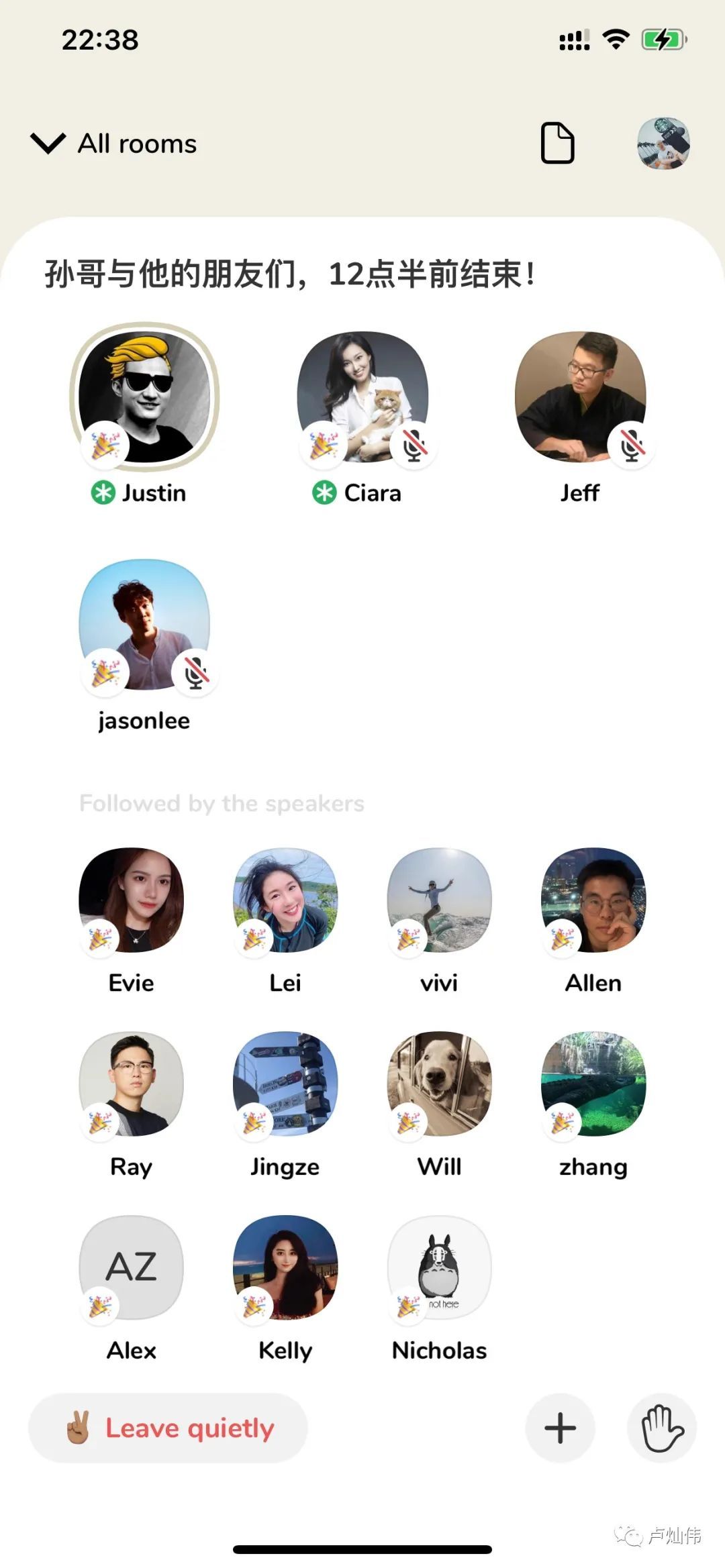
The Clubhouse room interface is divided into three parts: the first part is the host and guests, who are the voice chatters in this room. If you want to go on stage, you can raise your hand, and the host will pull you up. The second part is people related to those on stage, and the third part is purely the audience, like me.
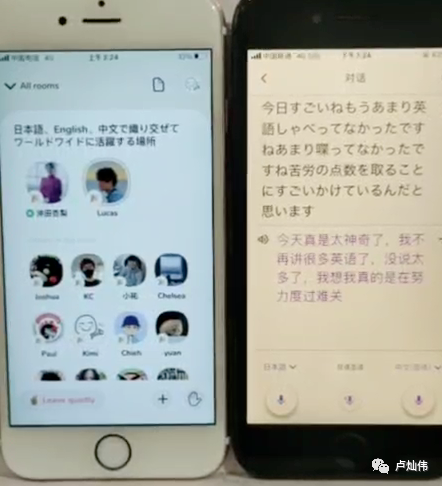
Clubhouse is open to the world, so you can see people from all over the globe chatting there; it feels like a large laboratory. Interestingly, someone has provided a solution for different languages, where you can use another phone for simultaneous interpretation to solve the problem of not understanding.
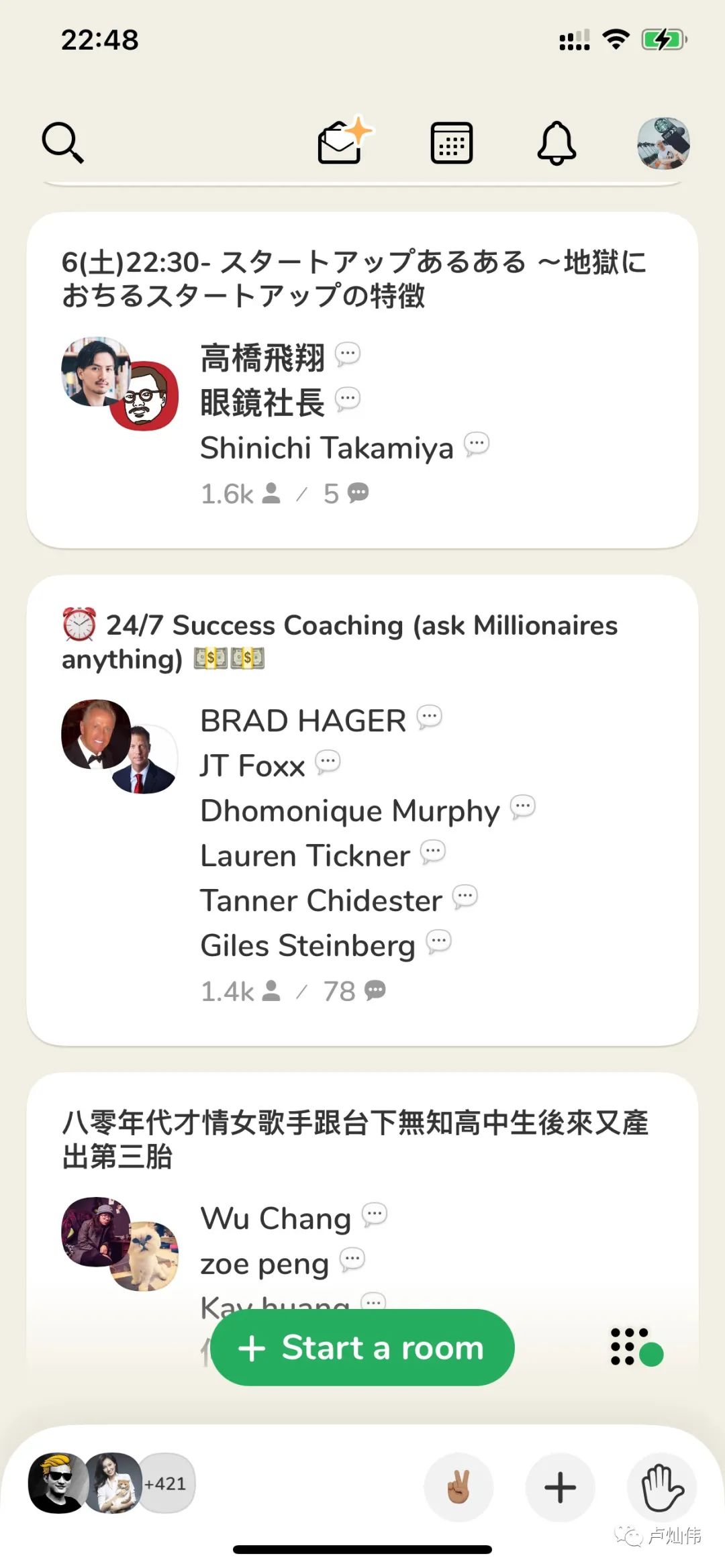
Some of the designed features are also quite interesting. For example, when you apply to speak, after the host agrees, you have to confirm again that you are willing to become a guest. When you are in a room, if someone you follow opens a room, you will receive a notification, but if you don't confirm immediately to watch, you won't be able to find it later.
In the context of the pandemic, many offline activities can no longer be held, leading to large-scale real-time semi-open online sharing sessions. Currently, we mainly use its rooms product; the Club feature requires an application.
My views:
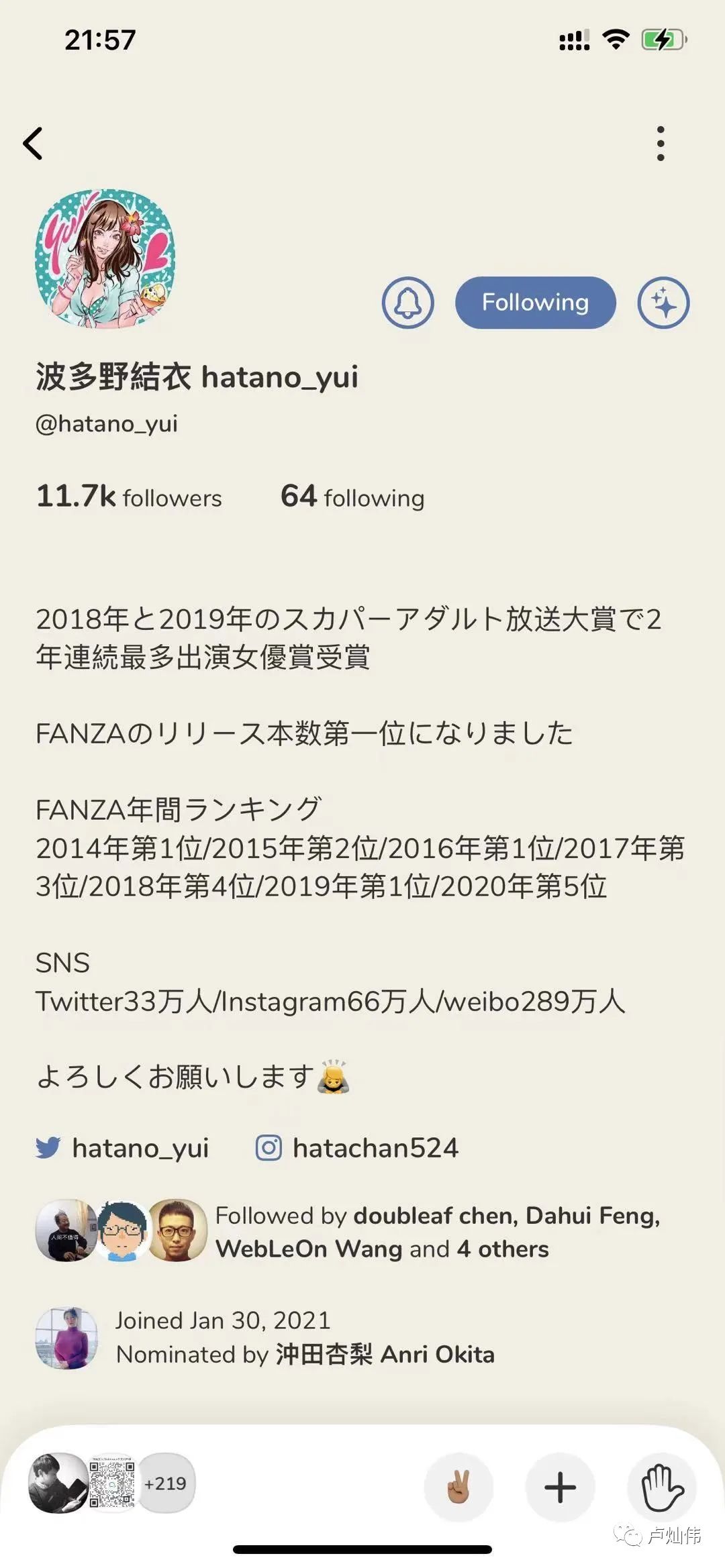
First of all, Clubhouse is invitation-based, allowing you to see the relationship chain, like the user below. You can slowly trace a user's relationship chain, and this relationship chain is public, which is beneficial for user attention. Unlike machine recommendations, it is a real connection chain.
Given the halving of prices on Xianyu, a large number of marketing accounts have followed suit, and many guest avatars directly display QR codes. In fact, there are already many low-nutrition rooms, increasing the cost of filtering. It is also possible that a new profession will emerge, that of a Clubhouse host, similar to live streamers. Although many products already have the feature of connecting voices, the functionality may be similar, but the logic is different.
I personally feel that it is closer to current podcast products, but the difference is that podcasts resemble traditional publishing, where authors and their friends publish, and it is unclear who the readers are. Clubhouse, on the other hand, is more like a collaboratively written book; you cannot know what the final content of the room will be or who contributed to it. One is about listening to audio, while the other is about participating in content creation. Even if you do not participate in the creation, you still do not know what the final produced content is.
Another feeling is that WeChat groups have transformed audio sharing into real-time voice sharing. In the end, Clubhouse will definitely see the emergence of a profession called content curators, who will organize the essence of room content and preserve it for future users to understand past content. Moreover, I have noticed that many rooms do not close, which makes it even more like a community, and I have also seen many people starting to operate in conjunction with WeChat groups.
Another aspect is the internationalization that many people talk about, and the ability to discuss relatively sensitive topics. I think this is not an advantage; not being able to access it is just a matter of time.
Another view is that, as mentioned earlier, WeChat audio sharing has turned into real-time voice sharing, and Zhihu is entering this field, with domestic giants following suit, trying to capture Clubhouse's users through aggressive means. This is also just a matter of time.
Of course, I cannot predict how the product will develop in the future, but I am sure it has opened a new era.
Recommendations:
Blindly trusting market research may ruin your brand.
How to quickly recover from adversity? Here’s a tool for you.
Not sure what you are good at? You might need to take the Gallup Strengths Assessment.
How to make the right choice? You need to know these two pieces of information.
The four stages of cognition: which stage are you in?
Did you know? Instant decision-making can be trained.
Why do I still feel tired even after sleeping for 8 hours?
Scan the code to follow 【Lu Canwei】, and send "self-media materials" in the background to receive two benefits for free:
1. A self-media tool package (worth 1999 yuan).
2. An electronic version of the "2020 Wealth Calendar," containing 365 money-making tips.
Appreciation has been canceled; "Looking" is the strongest support ↘