6 min read
"Product Manager Interview: Why Am I Told I 'Lack Structured Thinking'?"






Student A participated in a product manager interview. Due to insufficient preparation and nervousness during the interview, they did not showcase their personal strengths and ultimately did not pass. When they asked HR for the reason, the feedback was that they "lacked structured thinking."
Student B also participated in a product manager interview. With rich experience, their communication with the interviewer flowed smoothly, and they had a pleasant conversation, yet they also did not pass. When asked for the reason, the feedback was similarly that they "lacked structured thinking."
What? Huh?
What is structured thinking? How could it be lacking?
This is the real interview experience of some individuals, occasionally revealing a new symptom.
The most frustrating part is that they only mention the symptoms without providing a prescription.
The primary duty of a product manager is to identify and solve problems. Since the problem has arisen and appeared in their own experience, there is no reason not to resolve it.
What is structured thinking?
Structured thinking is a mode of thinking that organizes things in a structured manner, guiding thought and expression clearly from the whole to the parts, with distinct levels.
Using the pyramid principle as a thinking model, it breaks down, abstracts, classifies, and integrates problems, facilitating top-down thinking and divergence, enhancing the breadth and depth of thought.
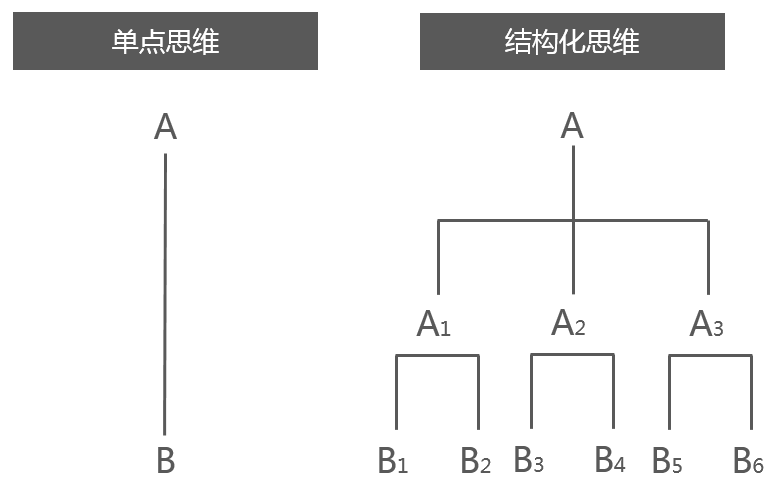
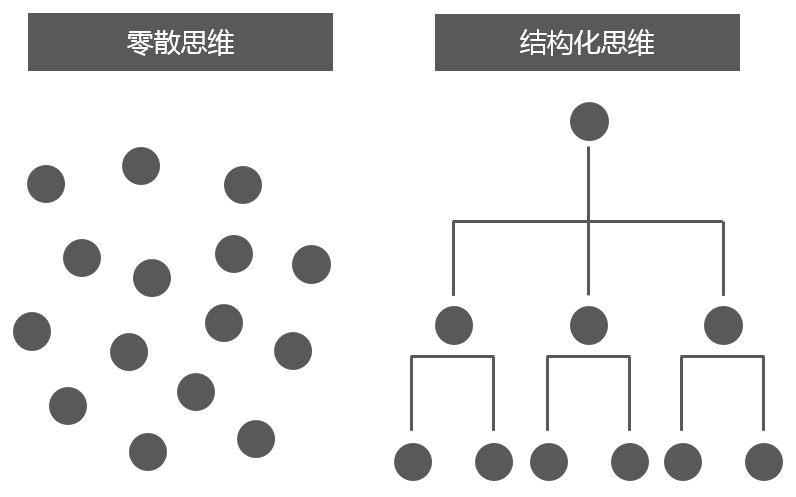
Individuals lacking structured thinking have a thought process that is singular, scattered, and chaotic.
In contrast, those with structured thinking have a layered, orderly, and clear thought path, like this:
Or like this:
Now, please recall if you have experienced the following situations:
• Lacking logical thinking, unsure where to start when faced with a problem.
• Speaking without order, saying a lot but failing to clarify the matter.
• Low efficiency in problem-solving, picking up bits and pieces, busy but not achieving ideal results.
If you encounter the above situations, it indicates that your structured thinking is indeed problematic and needs treatment!
Why do interviewers pay attention?
You might still wonder, even if there are deficiencies in structured thinking, it hasn’t affected my work results; product plans are designed, functions are launched as usual, and the outcomes are still good.
Shouldn’t interviewers place more emphasis on project experience and results?
You are correct; project experience and results are very important, otherwise, you wouldn’t be invited for an interview. However, they are not the only criteria for assessing fit.
Since interviewers are likely to be the direct supervisors of the candidates, in addition to assessing whether you can perform the job, they will also consider whether you can collaborate smoothly and connect well during the working process.
Thus, interviewers will comprehensively evaluate candidates' abilities and qualities, and assessing whether they possess structured thinking is one of those criteria.
If a hired person lacks structured thinking, it not only incurs additional management costs for the product leader but also increases risks and uncertainties in product design, team collaboration, and other areas.
If you were the product leader, would you be willing to take that risk?
How to improve structured thinking?
For product managers, whether to cope with interviews or for personal growth, structured thinking is an indispensable ability.
This ability will make your thoughts clear and orderly, help you grasp the key points of problems, and present information in a more systematic and layered manner.
To enhance structured thinking, start by changing your thinking habits. When facing problems, you need to cultivate awareness of focusing on problems, breaking them down, prioritizing, reasoning, and modeling.
- Focus
Focusing is to identify the key points of the problem and clarify the theme. This helps to define the boundaries of thought, avoiding overthinking or going off track.
Product managers often encounter open-ended questions in interviews, where the topics are broad and hard to tackle. To answer such questions well, it is necessary to clarify what the interviewer really wants to ask and then define a boundary for the question.
For example, when the interviewer asks you to introduce your experience in project xxx, what do you think the interviewer is thinking? Do they want to know the complete project process?
No, what they really care about is "you" in the project, so the focus should be on your role, thoughts, and contributions in the project.
- Break Down
Use the MECE analysis method to break a large problem into several smaller problems or to break a problem down into multiple perspectives.
Taking the introduction of project experience as an example, how can the question be broken down?
From the interviewer's perspective, the purpose of the question is simply to know:
Why was the project undertaken?
What role did you play?
What objectives did the project aim to achieve?
What were your thoughts?
What actions did you take?
What was the final outcome?
Thus, this question can be broken down into four dimensions: project background, task objectives, problem positioning, core actions, and project results.
For coarse-grained content, you can continue to break it down further. For example, the "core actions" can be divided into sub-dimensions such as user experience, product function design, business process improvement, and cross-platform collaboration.
- Prioritize
Prioritization relies on the results of the breakdown to distinguish between primary and secondary issues, as well as urgency, determining which problems to solve first and which to address later.
Prioritization can follow the four-quadrant rule, categorizing problems into four quadrants based on urgency and importance, and developing response strategies according to the importance and urgency of the issues.
When introducing project experience, if following a logical relationship, you can first discuss the project background, then the objectives, actions, and results; if you want to emphasize the final effect, you can start with the project results, followed by the background, objectives, and actions.
In summary, prioritization is to make your expression more logical and orderly. The more important, relevant, and highlight content should be expressed first, with concise language to avoid losing the interviewer's patience.
- Reasoning
Reasoning is used to support the conclusions drawn from structured thinking, making them real, objective, and more persuasive.
Methods include:
Product data: user numbers, retention rates, conversion rates, etc.
Calculation formulas: GMV = traffic * conversion rate * average order value, etc.
Theoretical models: RFM, MECE, dichotomy, etc.
For example, using RFM (Customer Value Assessment Model) analysis, it was found that 20% of important value users left due to being unable to find products, directly affecting platform transaction volume.
Therefore, the goal of this product iteration is to adjust the search strategy to address the issue of 20% of users leaving due to not finding products.
- Modeling
Modeling is the process of outputting the results of structured thinking, which involves constructing a mental model in the brain.
When initially cultivating structured thinking, you can draw the thinking model on paper or on a computer to develop a behavioral habit, and then gradually detach from the medium, integrating it into your own thinking.
This way, when facing problems, you can consciously use structured thinking to generate mental models in your brain and express them through language, making your answers more complete, logical, and layered.
In conclusion
In product manager interviews, being told you lack "structured thinking" mainly stems from two reasons: unclear and incomplete.
Unclear means you still do not know what structured thinking is, lacking logic, framework, and layers in your interview responses.
Incomplete means you already possess an awareness of structured thinking but do not master it thoroughly or deeply enough, or due to time constraints, you did not perform well.
I hope this article can provide you with some insights and help during your interview, starting from understanding structured thinking, and learning, accumulating, validating, and iterating in actual work to enhance your thinking ability.
——— This concludes the article ———
# Since you’ve come this far, why not take a look for a bit longer #