3 min read
"Read Less Dry Content, Read More Books"
This article is Lu Canwei's 119th original piece.
Click the blue 【Lu Canwei】 above to follow; remember to add a ⭐️ star mark~
Recently, I’ve been listening to a writing course that has great content, discussing a lot of foundational thinking and many conclusive points, but I just can’t understand it.
I spent a lot of time pondering whether it’s my problem? Or is it my problem? Or is it my problem?
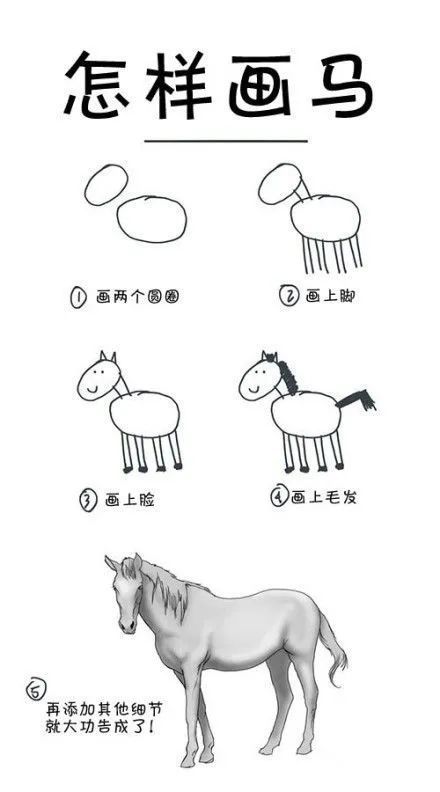
Suddenly, I remembered a popular image online about how to draw a horse.
1. First, draw two circles.
2. Then, draw two legs.
3. Next, draw the face.
4. Add the mane.
5. Fill in other details to complete it.
My feelings after the learning experience are somewhat similar to this; although I’ve summarized many methodologies, as a poor student, I still can’t grasp it. It’s like telling someone without a sense of prevention that they should buy insurance to guard against future risks, and they think you just want to boost your sales.
Case One
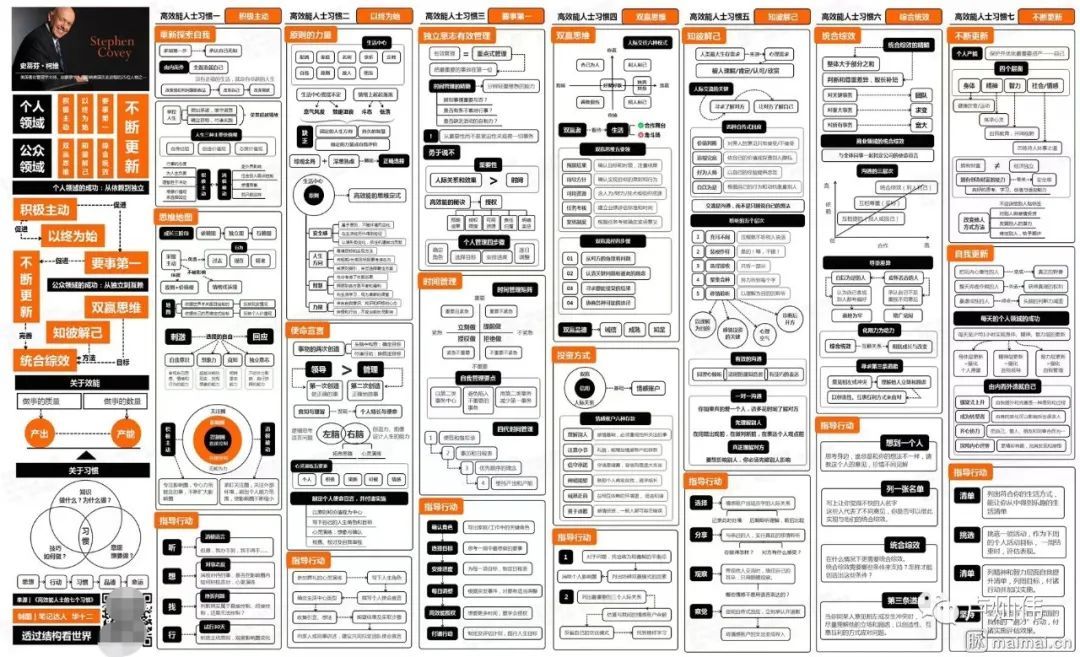
Now, many people summarize the core ideas of a book into practical insights, mind maps, and close readings to save you time. Then we end up with a bunch of conclusions, like the following points from "The 7 Habits of Highly Effective People."
I also saw someone kindly create a mind map, which is the one below.
When we read fragmented information, we usually provide a few examples to explain the content. But take being proactive as an example; how should I judge it in real situations? For instance, if a girl says no, does she actually mean yes? Should I be proactive in this case?
Case Two
Many people say that when looking for a partner, one should use the strategy of "playing hard to get." So I searched on a certain platform and found a similar question: "What is 'playing hard to get' in the process of pursuing a girl?" Here’s an excerpt from a highly-rated answer:
After reading this content, many students might just follow it, but this could lead to the following issues. So how do we make decisions?
I understand the conclusion of "playing hard to get" and what it means, but when it comes to real examples, I don’t know what to do. We lack a deductive process for this conclusion, so when we encounter specific situations, we can’t reverse-engineer our actions.
In other words, we lack the context for the conclusion. It’s like you’re talking to me about the conclusion on the tenth level while I’m still on the first level; I really can’t understand. But if you and I slowly deduce from the first level to the tenth level and then reach a conclusion, then I can understand.
This is why I particularly appreciate books that contain a lot of deductive processes, such as psychologists conducting different experiments on different people and then deriving a conclusion based on reference data.
However, many condensed contents nowadays largely overlook this point, only providing specific conclusions. After reading this content, I haven’t truly absorbed any knowledge; instead, I’ve just gained some lofty conversation topics for casual discussions.
Recommendations:
Ability and aesthetics are actually in your own control.
Stop saying you can solve problems through willpower.
Are you caught in self-doubt again? Here are a few suggestions to help you feel capable again.
I recommend a few books that I think are great.
If you’re unhappy at work and want to quit but don’t know what you want to do next, what should you do?
Scan the code to follow 【Lu Canwei】, and send “self-media materials” in the background to receive two free benefits.
1. A self-media tool kit (worth 1999 yuan).
2. An electronic version of the "2020 Wealth Calendar," containing 365 money-making tips.
👇👇👇 Feel free to click to follow~
"Watching" is the strongest support ↘