10 min read
"The Essence of Excellence"
This article is Lu Canwei's 151st original piece.
Click the blue 【Lu Canwei】 above to follow; remember to add a ⭐️ star mark~
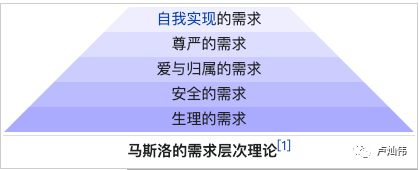
A few days ago, I watched a video about important psychological models by the director, which mentioned Maslow's hierarchy of needs. It's the diagram below.
Self-actualizers
I wonder how everyone defines self-actualization. If you ask me, my first reaction might be to marry a beautiful and wealthy woman, become a CEO, reach the peak of life, or more down-to-earth, to become rich overnight.
What is a self-actualizer? The director provided the following explanations:
I found that many excellent entrepreneurs possess the above traits, especially when facing their own problems, they are very honest about their ignorance. When confronted with issues, they habitually break down the problems to pursue their essence, allowing for more rational thinking rather than letting emotions dominate their minds; instead, they use emotions reasonably.
Insight and Acceptance of Reality
Although I currently cannot reach such a level of thinking, we know that it can be cultivated through training and deliberate practice to develop intuitive insight.
In our human system, there are many variables, and the connections formed by these variables create our system. Therefore, when we face certain problems, we must first realize that there is an issue with some variable in our system, rather than the system itself being faulty.
Here’s an example: you generously invite a young lady to a nice dinner, but when it's time to pay, you find you can't. At this moment, you feel very embarrassed, and then you call customer service, saying their system is terrible because you can't even pay. The customer service representative sweetly tells you that after investigation, the system is fine; it's a problem with the telecom company. Meanwhile, the technician handling the technical issues complains that the points team is doing a terrible job, dragging down their system, and that they must complain about them in the next meeting.
You realize that the "system" you refer to, the "system" the customer service representative refers to, and the "system" the technician refers to are not the same thing. Your "system" refers to the entire business, but you cannot pay, so for you, the system is a whole. For the customer service representative, the system includes both our system and external systems, such as telecom failures, Alibaba Cloud fluctuations, operator failures, etc. For the technician, his system includes our payment system and other teams' systems, like the points system mentioned earlier, which is not part of our system. For the frontend and backend, our system can further be divided into frontend systems and backend systems, and so on.
When we look at problems, we cannot simply conclude that the system is broken; we need to identify which specific part of the system is faulty. We must continuously break down and understand the essence of the problem.
For example, in a previous article, we mentioned self-fulfilling prophecies. I might say that I can't write this article today, and then when I go to sleep at night, I successfully fulfill that prophecy. We instinctively choose prophecies that are easy to achieve, like saying I don't want to exercise today, so I end up with a stomach ache.
In this regard, people often like to use Freud's theory of causation. It suggests that most of your current behaviors stem from the influence of your past environment. This seems reasonable, but it doesn't really help your growth unless you can, like in the Avengers, use a time machine to change the past.
Last year, I talked with a psychologist a few times about past experiences, including family matters. Although I felt relaxed after each session, there wasn't much change. So where did my sense of relief come from? Later, I realized it was about shifting the blame. The ones taking the blame could be our parents, classmates, friends, or various aspects of our past family environment and education; in any case, it wasn't my problem. If I have no problems, then of course I feel relaxed.
It wasn't until I read Adler's teleological theory that I understood that many of the problems people face now occur because they align with some inner purpose. For example, I have never understood why some people become alcoholics, waking up with headaches and discomfort the next day. In fact, alcoholism is a way of fulfilling a self-fulfilling prophecy; according to teleological theory, it might be a way to escape today, as getting drunk means waking up to tomorrow.
So why escape? It could be work-related or emotional. Only by peeling back the layers like an onion can we discover our true purpose. Why are people reluctant to face reality directly? It may be because they are unwilling to accept reality.
Everyone has heard people around them say things like, "If I were in that situation, I would definitely do better," especially after a few drinks. So they can maintain their impressive image in a dreamlike state without waking up. However, if they accept reality, they won't need to maintain an image but will instead seek solutions.
For instance, the education I received from a young age was about the futility of studying, and some relatives I later encountered held similar views. Reflecting on the once-popular entrepreneurial wave, I realize that the chaos I created back then stemmed from an unwillingness to accept reality. The entrepreneurial idols of that time were dropouts, like Steve Jobs and Mark Zuckerberg, but I never thought deeply about why they dropped out; it wasn't that they didn't study, but rather that the knowledge from school was less useful than what they learned on their own.
Only by accepting reality can we treat it as a problem rather than a fantasy.
I am good, you are not vs. I am not good, you are good
When you order a taxi through Didi and find that the car hasn't arrived and is not moving, what do you do?
Some people might get anxious and call the driver, possibly speaking in a not-so-nice tone, and might even scold the driver.
Others might wonder if the driver has some issue, if it's a fake car sent by the platform, or have various other thoughts.
Why do the same situation lead to two different perspectives? This involves two thinking models: one is "I am good, you are not," and the other is "I am not good, you are good."
The first is "I am good, you are not." In this case, we blame others for the problems. This is common in the workplace, where many people like to argue and insist their viewpoint is correct, believing that if the other party doesn't accept it, they are foolish. Essentially, I am good, and you are not.
The second is "I am not good, you are good." In this case, we blame ourselves for the problems. For example, in a breakup, if one party holds this mindset, they will likely say, "What did I do wrong? I can change." They will often receive the classic response, "You are great; we just aren't suited for each other."
We can see that the same situation can be interpreted differently. However, if you step outside of these two emotional states to think, your first action would definitely be to call the driver to understand the situation, then check how long the driver will take, whether it will affect your subsequent plans, and whether you need to order another car, etc.
In summary, you are finding a solution to your problem rather than catering to your emotions.
The Expedition Team
Let’s look at another example. In 1911, there was still a place in the world that had not been explored: Antarctica. At that time, two expedition teams set out to challenge this area. Team A had only four members, while Team B had 17. They almost set off at the same time (when you discover you have a genius idea, there are likely others thinking of it at the same time).
Which team do you think would arrive first? From a numbers perspective, the larger team should have the advantage and arrive first.
However, the result was that Team A, with only four members, arrived first. So does that mean having fewer people is better? But we should also note that when large companies fall, their bodies are still warm, like the once-mighty Nokia and Motorola.
Then Team A returned smoothly, while Team B arrived a month later and faced total annihilation on their return journey, with the captain of Team B freezing to death in the last ten miles.
Some might say that Team A was just lucky. However, they set off almost simultaneously, so they faced similar weather conditions, both good and bad. So why did Team B arrive a full month late and ultimately not return?
Fortunately, later explorers found their expedition diary and uncovered the truth.
Team A's four members brought three tons of supplies, while Team B's 17 members only brought one ton. This means Team A had a very high margin for error, while any mistake made by Team B would be fatal, indicating an inaccurate prediction of the project's difficulty.
Zhou Hang once said he underestimated the potential of the travel market, which is why he didn't raise much money and only focused on the private car market. However, Didi assessed that the market was large and the difficulty high, requiring a lot of money. Ultimately, Didi entered the private car market through the express car service and managed to pull Yi Dou down from the top market share in just three months.
So, is having supplies enough? If mistakes keep happening, then even three tons of supplies could run out quickly. Therefore, before setting off, Team A found similar environments for training; they spent months living with Eskimos in the Arctic, learning how to survive in freezing conditions. At that time, the Antarctic weather was considered summer and was actually quite pleasant. Team A used dogs to pull sleds, while Team B used faster horses.
I never understood why dogs were used to pull sleds, but later I learned that dogs do not sweat; they have no pores, so they pant to cool down. Horses are different; they can sweat. Although they run faster than dogs, when faced with extreme weather, sweating can lead to dire consequences...
In the end, Team B needed people to manually pull the sleds, which undoubtedly increased their burden.
Besides this reason, are there any other reasons?
From the exploration diary, we know that Team B would travel more in good weather and not at all in bad weather. If there were a period of continuous bad weather, Team B's progress would definitely be delayed, while Team A would walk 30 kilometers every day regardless of the weather. It was precisely during this month of delay that summer ended in Antarctica, and when Team B returned, they encountered extreme weather, ultimately leading to their inability to return.
This story was shared by Wang Xing on Meituan many years ago. What can we see from it? I see the importance of planning, setting goals, and sticking to execution.
Many times, we are too eager. For example, when a new thing comes out, we rush to do it, only to find that after a long time, there are no results. We invest blindly and start businesses without thought.
I increasingly feel that the wisdom of our ancestors holds true: haste makes waste.
Finally,
I’ve rambled on and written a lot. Recently, there has been too much chaotic input, but I am discovering that the essence of many things is the same. The qualities seen in outstanding individuals often overlap with those of self-actualizers. Although everyone is different, ways of thinking can also be categorized into several types.
Now we often talk about altruism, but if someone constantly demands from you, will you still be altruistic? Will you become a pushover? Some might say that such a statement is too absolute.
We need to elevate our perspective on issues and understand what the essence is. When a relationship is in a zero-sum game, your altruism might lead to the project's failure. If you think from an altruistic standpoint, the project could die. However, if you consider it from the project's perspective and adjust to eliminate the zero-sum game, turning it into a situation where both parties can grow the pie, you can share more of the benefits with them and exceed their expectations in delivery, leading them to also help grow the pie.
This world is more complex than we imagine, yet also simpler than we think.
Recommendations:
The Prisoner of Thought
How to enjoy what’s in front of you while keeping an eye on what’s ahead and thinking about what’s in the kitchen?
The harder you work, the more dispirited you feel? It might be because you haven’t mastered the right approach.
Scan the code to follow 【Lu Canwei】, and send “self-media materials” in the background to receive two benefits for free:
1. A self-media tool kit (valued at 1999 yuan)
2. An electronic version of the “2020 Wealth Calendar,” containing 365 money-making tips;
👇👇👇 Feel free to click to follow~
“Watching” is the strongest support ↘