4 min read
"The Four Stages of Cognition: Which Stage Are You In?"
This article is Lu Canwei's 35th original piece.
Click the blue 【Lu Canwei】 above to follow; remember to add a ⭐️ star mark~
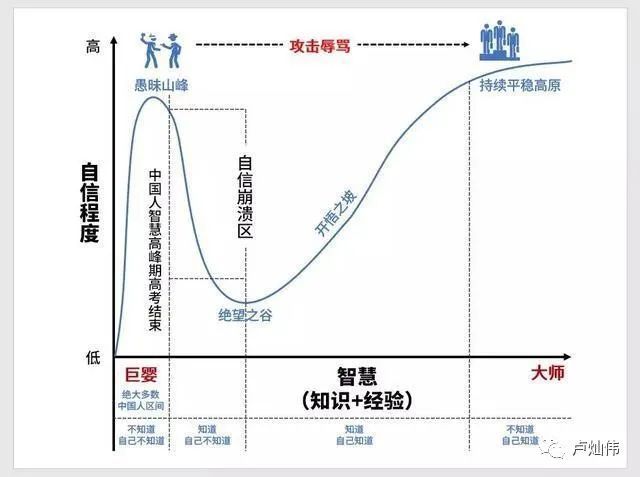
Today I saw a picture asking you to consider which stage you believe you are currently in.
Dunning-Kruger Effect
Abbreviated as the DK effect, it is a cognitive bias where individuals with a lack of ability have an illusory sense of superiority, mistakenly believing they are more competent than they actually are.
When they inflate their self-image to a peak of ignorance, they will fall back into the next stage, unable to recognize their own incompetence and unable to accurately assess their abilities. Interestingly, highly competent individuals often underestimate their own abilities, mistakenly believing that tasks they can accomplish easily can also be easily accomplished by others.
Dunning and Kruger first observed this cognitive bias in 1999 through experiments involving skills such as reading, driving, and chess. Their research found:
Dunning and Kruger believe this effect arises from the internal delusions of the incompetent and the misperceptions of the competent regarding the external world: "The miscalibration of the incompetent stems from a flawed self-assessment, while the miscalibration of the highly talented stems from a flawed assessment of others."
Anchoring Effect
Many times, we do not have a clear pricing for many things. For example, if you want to buy a hairdryer for several hundred yuan, if your anchor product is from Xiaomi, you might think it’s expensive. If your anchor product is from Dyson, you might think it’s cheap. Of course, I don’t have this worry because I don’t use a hairdryer.
This is because humans tend to rely excessively on previously acquired information when making decisions, and we use this fragment of information (the anchor) to make quick decisions. Therefore, when we receive something new, we easily categorize it based on previous experiences.
For example, take 4G and 5G. Many people think they are the same thing, that 5G is just a slightly faster version of 4G. So why hasn’t 5G been fully popularized yet?
First, it’s important to understand that the speed difference between 5G and 4G is mainly due to different frequencies. The higher the frequency, the faster the speed, but there is also significant attenuation during transmission, so 5G requires more base stations than 4G. So what can the slightly faster speed of 5G do? 5G brings about the rise of the Internet of Things and vehicle networks, rather than just allowing us to scroll through Douyin on our phones.
What I want to express here is not how powerful 5G is; if you take a little time to understand, you will find that it is a completely different thing. Therefore, sometimes we should set aside our previous perceptions and try to understand new things that seem similar.
Self-Awareness
After discussing so much, how is this related to what we talked about earlier? When we find ourselves in an environment, we often arrive at one of three conclusions: I am better than them, I am the same as them, or I am not as good as them. In most cases, if you ask someone in a project team about their contributions to the project, the conclusion they reach will always exceed 100%.
So when we arrive at a conclusion, it is very likely that the reference point we anchor to is our ideal self. At this point, we should set aside the current reference point and seek new reference points for comparison. This way, the conclusions we reach will be more realistic than our self-assessments.
Breaking out of our behavioral patterns is difficult for most people, so we must communicate, exchange ideas, and collide with strong individuals to see our true selves.
Framing Effect
First proposed by Amos Tversky and Daniel Kahneman in 1981, the framing effect suggests that when faced with the same problem, people will choose the option that sounds favorable or pleasant based on different descriptions. When asked in terms of gains, people tend to avoid risks; when asked in terms of losses, people tend to take risks.
Here’s an example:
An outbreak of a disease is expected to cause 600 deaths. At this point, there are two scenarios. Which answer would you choose in Scenario One? Which answer would you choose in Scenario Two? Why? Feel free to leave a comment.
Scenario One:
Option A: 200 people will survive.
Option B: There is a 1/3 chance that 600 will survive, and a 2/3 chance that no one will survive.
Scenario Two:
Option C: 400 people will die.
Option D: There is a 1/3 chance that no one will die, and a 2/3 chance that 600 will die.
You can reply with "Framing Effect" to get the answer and explanation. Does everyone think I spent a long time conceptualizing this article? But what if I told you it all started with just one picture?
Recommendations:
Did you know? Instant decision-making can be trained.
A little motivational tidbit.
Why do I still feel tired even after sleeping for 8 hours?
Breaking through the 5000-person limit? Let’s talk about WeChat 8.0.
What does it mean to have "value"?
Scan to follow 【Lu Canwei】, and send "self-media materials" in the background to receive two free benefits:
1. A self-media tool kit (worth 1999 yuan).
2. An electronic version of the "2020 Wealth Calendar," containing 365 money-making tips.
The appreciation feature has been canceled; "Looking" is the strongest support ↘