9 min read
"The Predicament of WeChat's Challengers"






Recently, three social apps were successively released, and WeChat once again took the blame, only to be banned by WeChat without exception.
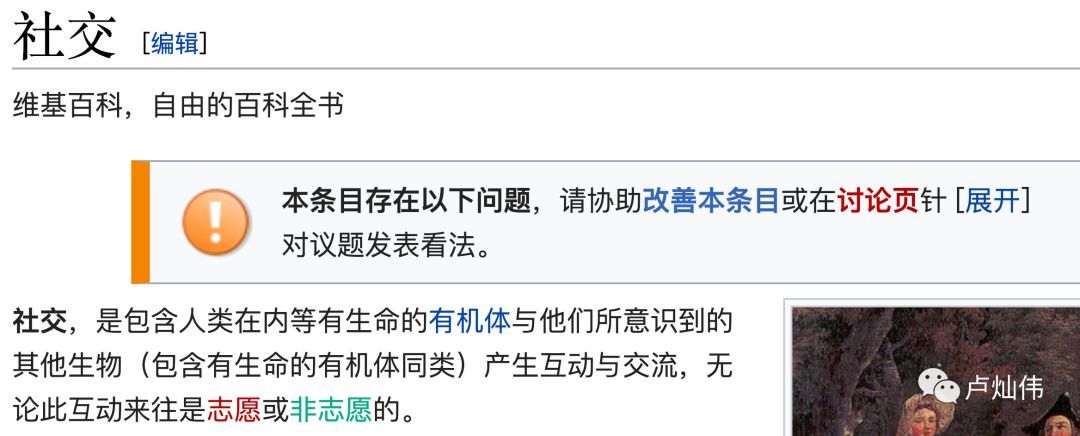
To this end, I specifically searched Wikipedia for what social interaction is.
This sentence is quite interesting; it includes interactions among living organisms, including humans. Theoretically, even helping your cat with its litter box is a form of social behavior.
Toilet MT: The Dark Corner of the Internet
Success and failure both stem from anonymity
Wang Xin led his team to launch Toilet MT, focusing on anonymous social interaction. Back in 2014, the anonymous social app Secret went live, and it took only 9 months from its launch to its announcement of closure. In 2014, the domestic app Wumi began creating a domestic version of Secret, which became extremely popular, quickly reaching the top of the App Store's free rankings.
Wumi officially claimed as early as 2014 that it adopted a mechanism of "machine review + manual review + reporting system" to reduce the large amount of negative information, rumors, and defamation on the platform, but this did not suppress the continuous stream of revelations and rumors.
In June 2017, the state promulgated the "Cybersecurity Law of the People's Republic of China," which stipulated that "network operators should require users to provide real identity information" and "rumormongers will face penalties under relevant laws and administrative regulations."
On August 21, 2018, Wumi was taken down, marking the official death of anonymous social interaction in the country.
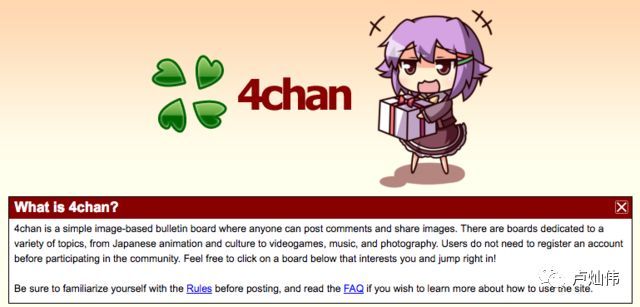
4chan: "The Dark Corner of the Internet"
When it comes to the ancestor of anonymous social interaction, many may not know that as early as 2003, a New York boy with the username moot established the English-speaking community 4chan, modeled after 2chan (a two-dimensional discussion community). One of the biggest features of 4chan is anonymous posting, and another is the short lifespan of posts; most boards have a limit of ten pages, and once the content exceeds this limit, old posts are permanently deleted. Posts on this forum typically last only a few hours to a few days, and administrators will also delete specific content.
In this context, the discussion atmosphere on 4chan is relatively "free" compared to traditional forums, easily becoming "politically incorrect." 4chan has produced a large amount of pop culture; for example, the expressions from "暴走漫画" (Crazy Walk Comics) originated from 4chan. In addition to these cultural symbols, the user base of 4chan has also planned numerous attacks and violent incidents online.
In 2006, a 14-year-old boy named Mitchell Henderson committed suicide. 4chan users believed that Mitchell killed himself simply because he lost an iPod, leading to the creation of a series of memes to mock this behavior. Some hacked into Henderson's MySpace page to add a zombie face, while others photoshopped his face into pornographic images, and some continuously harassed his parents with phone calls.
In 2010, an 11-year-old girl named Jessica Leonhardt became a victim of online violence from 4chan. Jessica faced a massive attack on her Tumblr page after a video complaining about online harassment was posted on 4chan's random board. Subsequently, Jessica uploaded a response video, and her father angrily warned the attackers, "You're done," which provoked an even greater reaction from 4chan. They mocked the response video and "doxxed" Jessica's family information. The Leonhardt family subsequently faced extensive harassment and even death threats.
In 2014, a large number of private photos of Hollywood actresses were published on 4chan. As a result, 4chan faced intense media backlash and criticism. The hacker who leaked the photos claimed that spreading these private images on 4chan was for the sake of Bitcoin. In January 2015, moot announced his resignation as the chief administrator of 4chan, stating that those months during the iCloud photo leak incident were the most stressful of his life.
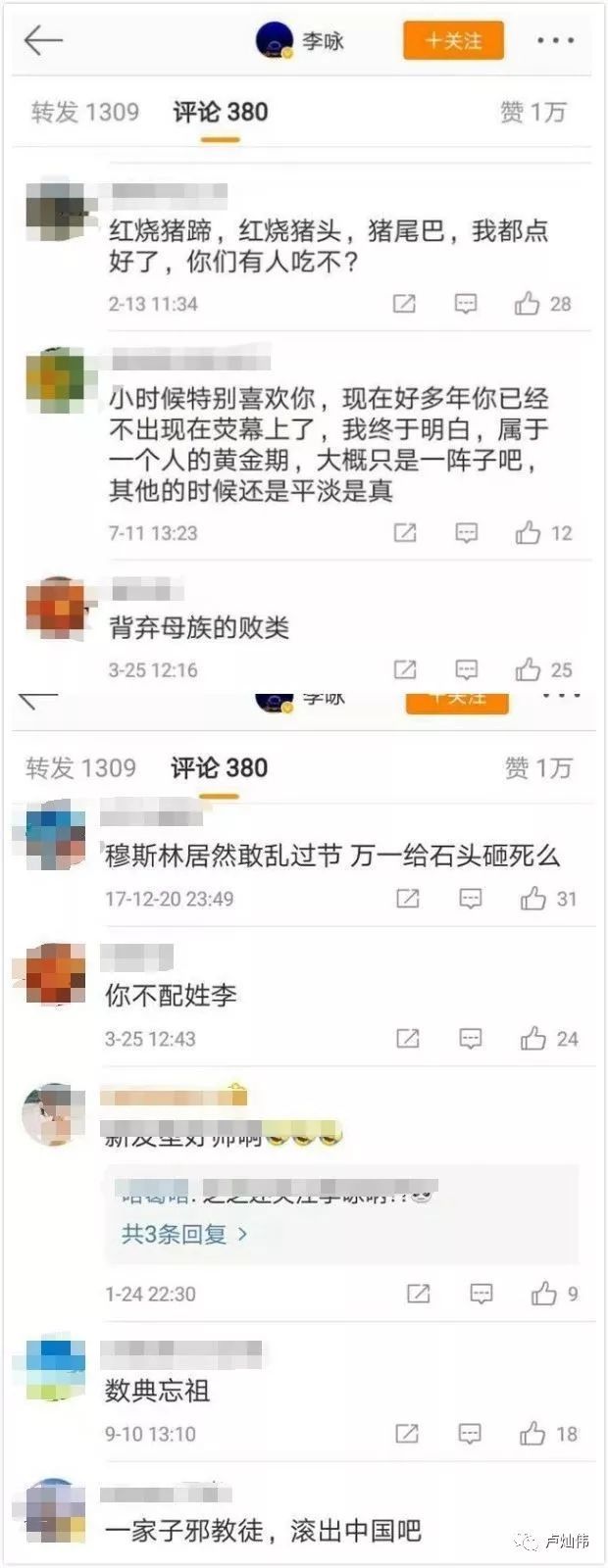
Even on real-name Weibo, online violence is rampant.
Marina Abramović's Performance Art
If the anonymity of the virtual network exposes the darkness of human nature, then can people in reality also transform into devils?
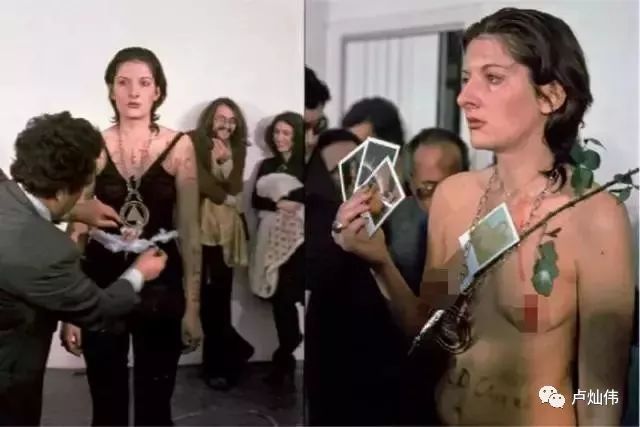
In 1974, Marina Abramović performed her most famous piece of performance art, "Rhythm 0." She first anesthetized herself and then stood in front of the audience at a table with 72 props (including a gun, bullets, a kitchen knife, a whip, and other dangerous items). The audience could use any of the items to manipulate her body as they wished, and she would not retaliate. Due to the unpredictable dangers of the work, Marina promised to take full responsibility for the performance.
At first, everyone was cautious, merely using lipstick to draw on her face. Seeing her unresponsive, some grew bolder and began to cut her clothes with scissors. When Marina stood naked before the crowd, people began to act without restraint. Some took photos of her naked body and shoved the pictures into her hands, others poked her stomach with rose thorns, and one even pressed a loaded gun against her head, fortunately being stopped by others. During the violence, Marina's eyes filled with tears, and she was filled with fear, yet she never fought back.
This piece lasted for 6 hours. After it ended, she stood up and walked toward the crowd, and the "thugs" who had perpetrated the violence, fearing retaliation, began to flee. Of course, Marina did not retaliate. In later interviews, she soberly recognized: "They really could do anything to me. If all decision-making power is public, then you are not far from death."
Six hours is enough to see through the darkness of human nature. The ugliness that lurks not too deep within humanity can quickly breed and spread once given soil. The perpetrators become bold in their exile, so no one should hold supreme power.
Regarding the spread of the dark side, what WeChat can do is to not be an accomplice within its capabilities.
Chat Treasure: A Social Tool for Ordinary Citizens
Luo Yonghao created a new growth method called conference-style growth.
On January 16, 2019, Luo Yonghao introduced the upgraded version 1.0 of the Bullet Messaging App—"Chat Treasure." This is a new product from Kuai Ru Technology.
Within 24 hours of its release, the number of activated users exceeded 1 million. Like Bullet Messaging, it rapidly exploded after launch, with a surge in user registrations.
After watching the release of Chat Treasure, everyone said that Old Luo's situation was terrible. The innovations in Chat Treasure regarding chatting are truly few, with a hodgepodge of functions, and the simple and crude promotional methods show no trace of the "sentiment" and "excessive design capability" that Old Luo once touted.
From starting to make air purifiers to chatting software and then to e-cigarettes, Old Luo has truly given up on mobile phones.
Many people have expressed their disappointment on Weibo, saying, "This is not the Old Luo I know," and "Don't say it was awkward at the scene; I felt awkward just sitting in front of my computer." However, some still expressed understanding, saying, "As long as he survives, Old Luo has said that this is about sinking into third and fourth-tier cities."
From the very first day of its birth, Chat Treasure began to monetize.
According to Chat Treasure's normal exchange rate of 1700:1, if you want to earn the minimum withdrawal amount of 30 yuan, you need to obtain at least 51,000 coins. Roughly calculating, if I complete the novice tasks and daily tasks, I can earn about 1000+ coins.
That’s probably less than 60 cents. Buying a user for 60 cents is incredibly cost-effective. Moreover, this money doesn't even come out of your own pocket; it comes from advertisers. In the early days, food delivery, ride-hailing, and coffee all relied on coupons to acquire users, with the cost per user ranging from 15 to 30, which is quite high, and it also requires offline operational expenses.
If we calculate based on 100 coins per task, the cost per click is less than 5 cents, which is truly a bargain!
As a communication tool, WeChat is basically unshakeable. Even Taobao can only take a backseat, using "voice commands" to create a small opening on WeChat. When you use Windows, IE is implanted as the default browser, and what happens? Everyone uses IE to download Chrome and then never uses IE again. Currently, Chrome holds a market share of 61%, while IE only has 12%.
Since rules cannot be set, one must create a new world. This allows advertisers' information to spread more easily. If within WeChat's system, once banned, advertisers' interests cannot be guaranteed, then it makes sense for Chat Treasure to include communication functions.
The success of Pinduoduo has already proven that the strategy of "surrounding the city from the countryside" is feasible, but for WeChat, this kind of bargain information dissemination is detrimental to WeChat's ecological development, like a stubborn sore that must eventually be dealt with. For WeChat, relationships should not be excessively overdrawn.
Thus, for Pinduoduo and Alipay, there is an urgent need for a new space to disseminate "advertisements," and at this moment, Chat Treasure emerged, forming a strong alliance. Users know that they are coming in to watch ads and can earn money.
This is also why it is called Chat Treasure, because there really is treasure.
Duoshan: A Social Tool for Non-Acquaintances
At first glance, one might wonder why Douyin has created a separate app for private messaging.
Years ago, Renren also separated its private messaging feature into a standalone app, which was later integrated back. Another example is Facebook, which successfully turned Messenger into a separate app.
However, Duoshan is different from the two mentioned above. Why is that? The former are based on familiar social interactions, while Duoshan belongs to the category of non-acquaintance, non-stranger social interactions.
How do we define non-acquaintance, non-stranger? It refers to social interactions with acquaintances at a three-point, five-point, or seven-point familiarity.
When it comes to stranger social interactions, the first impressions are usually of Momo and later Tantan. Ultimately, the conversation leads to, "Add me on WeChat, let's chat there."
For someone who is a three-point, five-point, or seven-point acquaintance, WeChat contains too much personal privacy. You definitely do not want someone you have never met to see your personal information.
The viral videos that can continuously be produced on Douyin are essentially PUGC (Professionally User-Generated Content), and the production of high-quality creative videos comes with costs and barriers. For ordinary people, it often consists of trivial daily life and uninteresting records, but I do not want this information to become a burden for me.
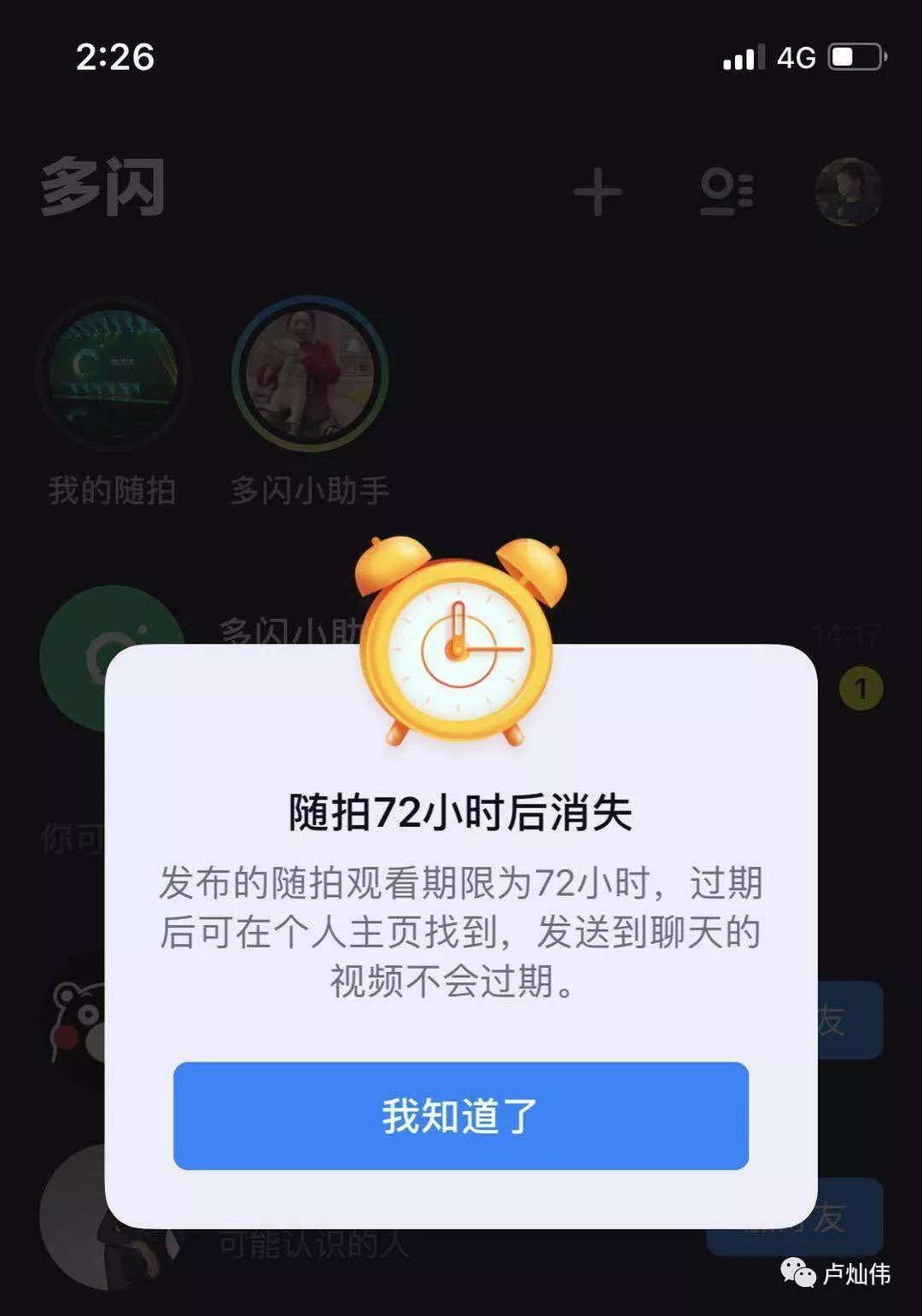
This is also why Duoshan needs the "self-destruct after reading" feature. As for why it starts with short videos, there is an interesting phenomenon: many mainstream social apps, both domestically and internationally, have introduced the Story feature, such as WeChat video dynamics, Weibo stories, Instagram stories, YouTube stories, and Facebook stories. They typically place this entry point in the user's avatar, allowing users to click on the avatar to view videos. This feature has revitalized many social apps that were originally somewhat dull, making them more engaging.
Video social interactions lean towards entertainment and scene recreation, and Douyin's essence is short videos. As an extension of Douyin's social aspect, it naturally starts from short videos.
Although ultimately all familiar relationships will settle back into WeChat, there may come a day when establishing non-acquaintance relationships will turn into, "Add me on Duoshan to chat."
I am Sanvi. If you find this interesting, please give it a thumbs up.
All images in this article are sourced from the internet. If there is any infringement, please contact the author for removal.
文中图片均来源于网络,如有侵权请联系作者删除