9 min read
"Why Do I Sleep 8 Hours Every Day but Still Feel Tired?"

This article is Lu Canwei's 32nd original piece.
Click the blue 【Lu Canwei】 above to follow; remember to add a ⭐️ star mark~
Do we really need 8 hours of sleep?
Today, let's talk about sleep. Since childhood, we have been indoctrinated with the idea of 8 hours of sleep, but have you noticed that some people need to sleep for 10 hours to feel refreshed, while others feel energetic after just 4 hours of sleep?
I am someone who has poor sleep quality. For several years now, I have been troubled by insomnia and once hoped to solve my sleep problems with sleeping pills. However, after taking the medication, I felt fatigued all over the next day and felt very unwell.
I wonder if anyone else has had the same experience as me, where you feel particularly alert at night, with endless thoughts racing through your mind, unable to enter a sleep state, watching the time tick away, growing increasingly anxious, and then starting to calculate how many hours of sleep I can still get. Will I die from such little sleep? Gradually, the sky begins to brighten, the birds start to chirp, and the early risers finish their lives.
Later, I began to try melatonin, which is produced in response to changes in surrounding light and helps regulate sleep. However, with the presence of artificial light and technological devices, when you use your phone, the blue light emitted interferes with melatonin production. There is also a dosage issue with taking melatonin, as it is a medication, and it can easily lead to poor energy levels during the day. The melatonin I purchased has now become a decoration in my home.
Sleep Cycle
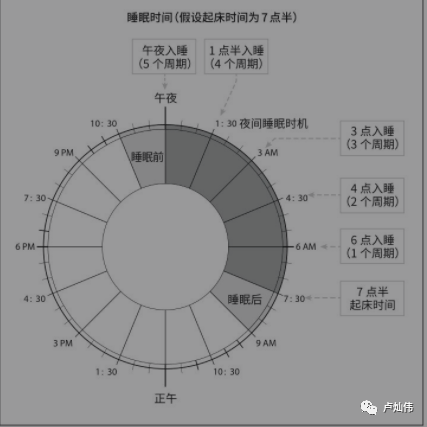
This concept was first proposed in 1968 and has been continuously revised over the following decades. R90 refers to a sleep cycle of 90 minutes, with most people typically completing 4-5 cycles. When you sleep for 5 cycles, it is equivalent to sleeping for 7.5 hours, which is quite close to my average of 8 hours.
Our sleep cycle can be divided into several stages:
Light Sleep (Non-REM Sleep)
I wonder if anyone has experienced this: feeling like you are climbing stairs, suddenly stepping into thin air and falling, then waking up. This kind of hallucination usually occurs in this stage, which is the first stage of sleep, indicating that we need to fall back asleep.
If we continue to fall asleep, we will enter the second stage. In this stage, if someone suddenly calls you, you can still be awakened.
Deep Sleep
If you have ever woken up feeling dizzy and unable to see clearly, that is what we refer to as being "sleep-drunk." When you are awakened during this time, you are actually in deep sleep. Typically, our bodies repair themselves and store memories during this phase. The longer you stay in deep sleep, the better your energy levels will be the next day. Generally speaking, deep sleep accounts for about 20%-60% of total sleep time.
REM Sleep
We usually dream during this phase. At this time, our body's muscles are in a low-tension state. If, for some unknown reason, you become conscious while your muscles are still in this low-tension state, it can lead to a situation where you cannot move, commonly known as "sleep paralysis."
Although the R90 sleep cycle is based on a 90-minute cycle, this is also an average value. Typically, an adult's sleep cycle ranges from 70 to 120 minutes. This is why you may have heard of people who only need 4 hours of sleep, while others sleep for 6.5 hours. Therefore, you can adjust and find a sleep cycle that suits you.
Sleep Practices
Preparation Before Sleep
However, for us, it is impossible to maintain such a fixed schedule every day. We often cannot go to bed on time due to various reasons, such as working overtime, weekend gatherings with friends, and so on. Therefore, sleep cycles should not be observed on a daily basis.
As long as you complete 28-35 cycles per week, that is sufficient. However, this is also an average value, and you should try not to have three consecutive days below the average sleep cycle. For example, if you sleep for only 2 cycles for several days in a row, you should aim for at least 4 nights of sufficient sleep each week.
So can I play on my phone until it's time to sleep? Of course not, if you don't want to feel very alert when you lie down. Therefore, preparing for sleep in advance is necessary. At this time, you should turn off your phone. If you can't do that, try to enable the night mode on your phone to warm up the color temperature of the device.
Additionally, the temperature of the room is also very important; it should not be too cold or too hot. My current habit is to turn off all heating devices before bed to avoid the room becoming too warm, after all, you still need to cover yourself with a blanket to sleep.
Avoid drinking water and eating within 90 minutes before sleep. Drinking water can cause you to wake up in the middle of the night to urinate, and eating can leave food in your stomach, making it difficult to fall asleep or resulting in poor sleep quality.
Light is also very important. I use blackout curtains to ensure that the room remains dimly lit, and I have replaced my desk lamp with one that has a warm color and can simulate sunlight.
Even so, if I still can't fall asleep, what should I do? At this point, you might open your phone, scroll through social media, and the blue light continues to disrupt your sleep, leading to a vicious cycle.
Currently, I use a backlight-free Kindle for reading. The Kindle can directly access the web version of WeChat Reading, and since there is a bedside lamp in the room, it generally works well.
Napping During the Day
Some may ask, if I need to prepare for an exam and can't sleep for long, or if I work late but still want to have my own time, what should I do?
So we don't need to worry too much about not being able to sleep; you can make up for it the next day.
This is where napping comes in. You may have noticed that many people in the office have a habit of napping during lunch. The best time for a nap is between 1-3 PM and 5-7 PM. Set a timer for about 90 minutes of work, then get up to drink some water and stretch for a few minutes to give your brain a break.
However, you should try to keep your daytime nap to under 30 minutes. Why? Because this can prevent you from entering deep sleep. I'm sure you've experienced the so-called "sleeping dead" during lunch and how painful it is to wake up.
At one point, I set my nap for 30 minutes, but I found that when I woke up, I couldn't see clearly and felt dizzy. After practicing for two weeks with 20-minute naps, I felt it was quite good, but it doesn't always work well every time. Next, I will try setting it to 26 minutes.
Morning Preparation
We have all experienced the reluctance to get up in the morning; I also love to stay in bed. I have fallen into the habit of taking a second nap every morning. Suddenly depriving myself of this delightful experience seems a bit cruel, so I use some auxiliary methods to solve this problem. For me, I use a smart lamp to wake me up, automatically simulating bird calls and sunlight, with a wake-up duration of up to 30 minutes. After waking up, I take a second nap before truly getting out of bed.
I have stopped using an alarm clock to wake up, as it is a rather harsh method. In the past, we would set 5 alarms, repeatedly turning them off. Now, in addition to the lamp, I also use the vibration of a wristband to wake me up.
Sleep Monitoring
Currently, I mainly use two tools: one is the Sleep Cycle app for monitoring, and the other is a wristband. I do cross-comparisons. The wristband has a problem; you need to wear it tightly at night, otherwise, the data on deep sleep ratio can be significantly inaccurate.
In Conclusion
Many times, we focus on quantity rather than quality. For example, we pay more attention to how long we sleep rather than the quality of our sleep. A few days ago, I read Li Xiaolai's "Treat Time as a Friend," where he mentioned that at first, he envied those who only slept 4-6 hours a day, as they gained an extra 2 hours each day, totaling 60 hours a month, while he needed to sleep for 8 hours.
Later, he found a method to sleep for 4 hours each night, with 30-minute naps in the afternoon and evening. I believe he must have specifically studied sleep and practiced to find a sleep method that suits him; otherwise, why wouldn't he sleep for 4.5 hours or 6 hours?
In practice, I also encountered many issues. In the first two weeks, I didn't feel particularly energetic during the day and relied entirely on coffee. Now, I have reduced my coffee intake and only drink it in the morning, so by evening, it is mostly metabolized.
Even if I drink coffee in the afternoon or evening, it doesn't matter; I just need to push my sleep time to the next cycle. This way, I have an extra hour and a half for reading.
Weekends are a significant issue; I still can't get up at the same time as usual. So now, I simply give up on a regular wake-up time on weekends and adjust according to my sleep time, as long as I meet my sleep cycle, it doesn't matter whether I wake up at 7:30 or 11.
Currently, my sleep time ranges from 4.5 to 6.5 hours, and I decide whether to have a snack at noon based on the situation. The same goes for the evening; if I feel tired, I take a short nap to adjust.
If I lie down for more than 10 minutes without falling asleep, I get up to read. When it’s close to the next cycle, I go back to sleep, and I can usually fall asleep within 10 minutes (no longer envying those who can fall asleep in seconds).
This is also one of the reasons why my friend says I have been in the top rankings on WeChat Reading for a long time, because I have more time than he does. After monitoring for a while, I found that my initial effects on falling asleep and deep sleep were not good. Since I have cats at home, if they are active at night, I get really frustrated. On my friend's recommendation, I bought earplugs, and my deep sleep ratio can basically reach over 20%. I am currently trying more methods to improve my deep sleep ratio.
Yesterday, I listened to a talk by Mu Wen, who said he can maintain about 2-3 hours of deep sleep. Based on his sleep time, his deep sleep ratio is close to 50%, which gives him more time to manage his community, video accounts, and study.
Recently, I started practicing the time tracking mentioned by Li Xiaolai. I can recommend an app called "Toggl Track." This article took me 1 hour and 32 minutes to write. By tracking how you spend your time each day, you will have more data to effectively optimize your time and work efficiency.
The only advantage ordinary people have is time. As long as you use it more effectively, time will gradually benefit you.
Recommendations:
Break through the 5,000-person limit? Let's talk about WeChat 8.0.
What does it mean to have "value"?
Your misfortune is actually your own choice.
Scan the code to follow 【Lu Canwei】, send "self-media materials" in the background to receive two benefits for free:
1. A self-media tool package (worth 1,999 yuan).
2. An electronic version of the "2020 Wealth Calendar," containing 365 money-making tips.
Appreciation has been canceled; "Looking" is the strongest support ↘